Medical Image Sharing in 2026: How to Send DICOM Studies Securely Without CDs
Burning a DICOM study to a CD takes 20 minutes and often arrives unreadable. Meanwhile, patients and referring physicians expect images the same day, and a courier can't match that pace. Cloud image exchange now replaces physical media for most routine transfers.
This article explains how secure DICOM sharing works without discs in 2026. You will learn how a cloud platform ingests studies through a DICOM gateway, how a zero-footprint viewer supports image exchange, and which compliance standards (HIPAA, GDPR, OWASP) to check. By the end, you can judge whether Medicai fits your hospital, imaging center, or teleradiology workflow.
What Is Medicai and Why It Matters for Secure DICOM Sharing in 2026
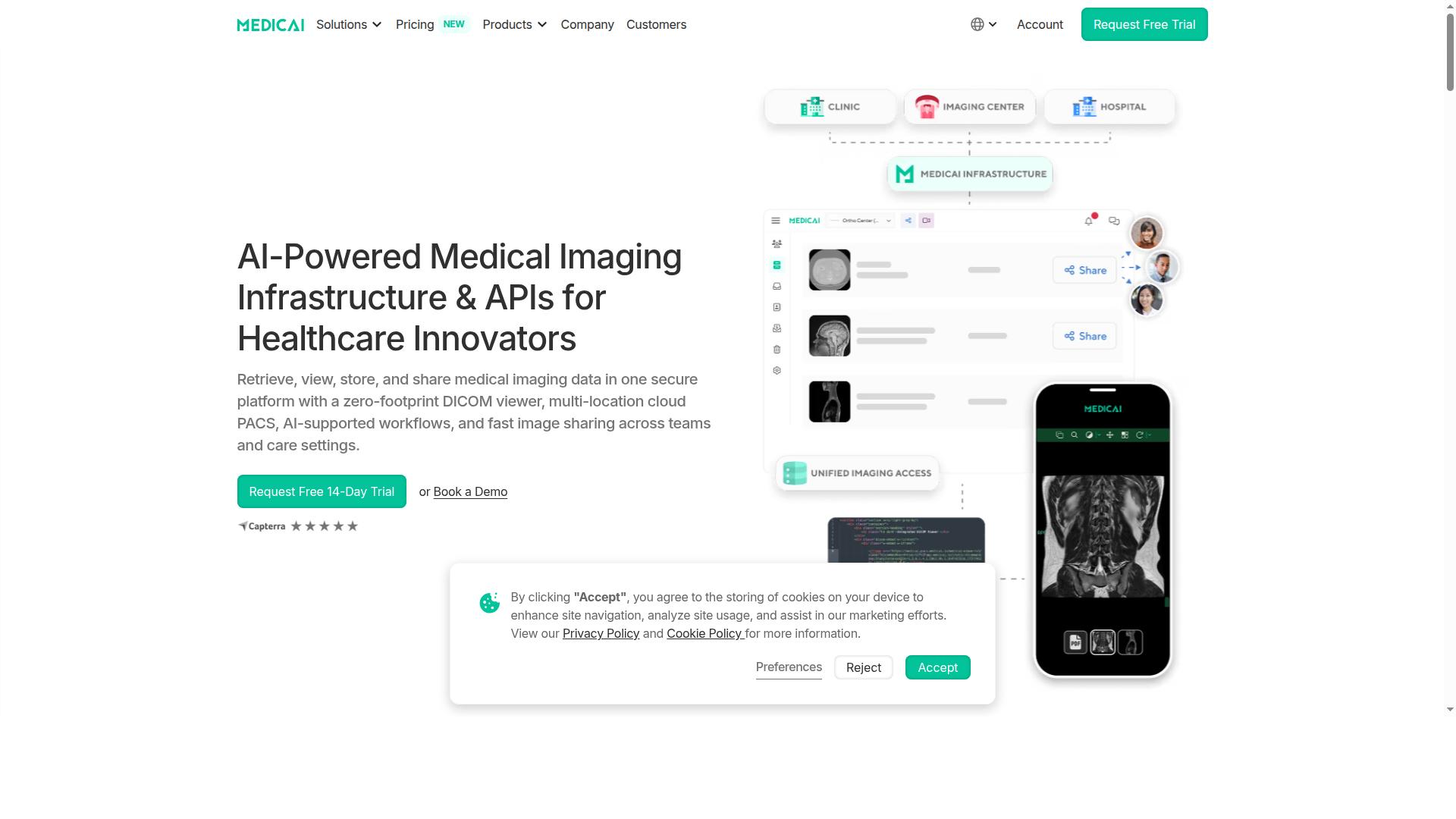
Medicai is a cloud-based medical imaging platform that enables healthcare providers to securely store, view, and share DICOM studies without physical media. It combines a zero-footprint DICOM viewer, cloud PACS, and secure image exchange in one environment, so a study can move from scanner to specialist without a disc ever changing hands.
The platform is built by a VC-backed healthcare startup focused on modernizing imaging workflows and enabling interoperability. Its track record is concrete: more than 2M imaging studies uploaded, 1.7M+ studies in storage, 70 clinics and hospitals on the platform, and 10,000+ active doctors.
Why this matters in 2026 comes down to three pressures. Cyber threats against health data keep rising, interoperability requirements keep tightening, and patients and referring physicians increasingly expect images to arrive in minutes rather than by courier.
- Security: Medicai is HIPAA and GDPR compliant and follows OWASP security guidelines, which matters as ransomware and PHI breaches dominate healthcare risk registers.
- Interoperability: cloud image exchange removes the CD handoff that stalls referrals between hospitals, imaging centers, and specialists.
- Speed: the platform reports reducing diagnosis time by 65%, a direct argument against physical media delays.
In short, Medicai replaces the CD workflow with a secure, browser-based one. That makes it a practical reference point for any organization planning its 2026 imaging strategy.
Who Medicai Serves: Hospitals, Imaging Centers, Teleradiology and Beyond
Medicai's platform is designed for a wide range of healthcare providers, including hospitals, imaging centers, and teleradiology groups. Each type has a different sharing bottleneck, and secure DICOM exchange addresses them in distinct ways.
Hospitals deal with the heaviest volume and the most handoffs between departments and outside facilities. A cloud PACS with a zero-footprint viewer lets clinicians open studies from any workstation without installing software, while access control and audit trails keep PHI protection intact.
Imaging centers live on turnaround time. Sending studies through secure image exchange instead of burning and couriering CDs shortens the loop between scan and report, and it removes the cost and failure rate of physical media.
Teleradiology services depend on remote readers receiving complete studies quickly. Browser-based access means a radiologist on call can review a case from anywhere, with the same diagnostic viewer experience as on site.
Specialty care providers form another large group, and each benefits from receiving images in a form suited to their workflow:
- Orthopedics and neurology: need prior studies for comparison, so fast access to historical imaging supports better surgical and clinical decisions.
- Oncology and tumor boards: require multi-specialty review of the same study set, which secure image exchange makes practical across sites.
- Cardiology, pulmonology, and gastroenterology: rely on timely imaging to guide procedures and follow-up.
- Ophthalmology, ob-gyn, and dentistry: benefit from sending studies to referring clinicians without physical handoffs.
Beyond clinical providers, Medicai also serves virtual care providers, telemedicine platforms, personal injury lawyers, clinical trials, and medical education organizations. Patients are covered too, through the Patient Portal, which gives them a direct way to access their own imaging. For all of these groups, the common thread is the same: secure DICOM sharing that works without a CD, and a platform available worldwide online.
Can You Really Send DICOM Studies Securely Without CDs in 2026?
In 2026, sending DICOM studies via CDs is not only outdated but also poses significant security and efficiency risks. Yes, you can share medical images securely without physical media, and the case for doing so is stronger than ever. Cloud-based image exchange platforms now handle the same studies that once traveled by courier, with better protection and faster delivery.
The problems with CDs are well documented and practical. Discs get lost in transit, scratched beyond reading, or misplaced in filing cabinets. Once a CD leaves a facility, no one can track who opens it or where it ends up. Many are burned without encryption, which means a single lost disc can expose protected health information.
Delays matter too. Overnight shipping or hand delivery can add days to a referral, a second opinion, or a teleradiology read. In urgent cases, that lag affects care directly. Cloud platforms replace the courier with an encrypted transfer that lands in minutes, not days.
Security and compliance concerns push the shift further. CD workflows rarely produce a reliable audit trail, and they struggle to satisfy HIPAA compliance or GDPR obligations around access control and PHI protection. Modern image exchange platforms address these gaps by design, using encrypted transmission and role-based access rather than a plastic disc in an envelope.
The sections below explain why CDs are obsolete and how Medicai's cloud platform removes physical media from the workflow entirely.
Why CDs Are Obsolete - and What Replaces Them
CDs are increasingly obsolete due to their vulnerability to loss, damage, and unauthorized access, as well as their incompatibility with modern interoperability standards. A disc is a single point of failure. If it breaks, the study is gone until someone re-burns it, and re-burning takes time nobody in a clinical workflow has to spare.
Physical degradation is a quieter problem. Optical media has a limited shelf life, and discs stored in warm or humid conditions can fail long before anyone expects. A study that reads fine today may be unreadable in a few years, which is a poor foundation for long-term record keeping.
Tracking is another weak spot. Once a CD is handed off, there is no reliable record of who accessed the images or when. That gap makes audit trail requirements hard to meet and weakens PHI protection across the chain of custody. Unencrypted discs compound the risk if one is lost or stolen.
Regulatory expectations have moved on as well. HIPAA compliance and GDPR both push toward controlled access, encryption, and accountability, and a mailed disc offers little of any. Interoperability standards such as DICOMweb, HL7 FHIR, and IHE profiles assume networked exchange, not physical handoffs.
What replaces CDs is a cloud-based image exchange platform. These systems move studies over encrypted transmission, enforce access control and role-based access, and keep an audit trail of every view and download. Many add multi-factor authentication and support data residency choices for GDPR. The result is secure transfer that is faster, traceable, and easier to govern than any disc.
How Medicai's Cloud Platform Eliminates Physical Media
Medicai's cloud platform replaces CDs by allowing providers to upload, store, and share DICOM studies entirely online through a secure, zero-footprint DICOM viewer. It is a cloud-based medical imaging platform that provides Imaging Infrastructure as a Service (IIaaS), and it is built to remove physical media from the imaging workflow.
The workflow has three clear stages. First, studies come in through the Medical Imaging Uploader or the DICOM Gateway, which connect imaging sources to the platform. Next, studies are stored in the Cloud PACS, a multi-location system that keeps images accessible without a local server. Finally, providers share studies through the Medical Image Exchange, so recipients reach the images without a disc, a courier, or a software install.
The viewer is central to the experience. It is a zero-footprint DICOM viewer, meaning it runs in a browser with nothing to download. Clinicians can open studies from the Doctor Imaging Portal or the Patient Imaging Portal, and the platform includes FDA/CEE cleared viewers for diagnostic work. A Mobile Imaging App extends access to phones and tablets.
Security and compliance sit underneath the whole flow. Medicai is HIPAA and GDPR compliant and follows OWASP security guidelines, with a Microsoft Azure partnership supporting the infrastructure. Sharing through the platform is a different proposition from a disc in the mail, where access ends the moment the envelope is sealed.
The efficiency gains show in the platform's track record. Medicai reports over 2M imaging studies uploaded, more than 1M studies transacted or processed per year, and 70 clinics and hospitals on the platform. It also reports a 65% reduction in diagnosis time. For organizations still burning discs, the contrast is straightforward: faster sharing, traceable access, and no physical media to lose.
How Secure DICOM Sharing Works on Medicai
Medicai's secure DICOM sharing workflow integrates ingestion, storage, and access through a combination of gateways, cloud PACS, and standards-based APIs. The platform is built as Imaging Infrastructure as a Service (IIaaS), which means the imaging stack is delivered online rather than installed on local servers.
In practice, a study moves through three stages. It enters through a DICOM Gateway or the Medical Imaging Uploader, is stored and organized in a cloud PACS or vendor neutral archive (VNA), and is then shared with referring physicians or patients through an image exchange platform and a zero-footprint viewer.
Interoperability rests on recognized standards. The platform uses DICOMweb services and HL7 FHIR for patient context. These standards replace the courier and CD workflow with an auditable, browser-based exchange.
The scale behind this workflow is real. Medicai reports 1M+ studies transacted or processed per year, 2M+ imaging studies uploaded, and 50M+ yearly API transactions across 70 clinics and hospitals. The three subsections below cover each stage: getting studies in, storing and viewing them, and the compliance controls that protect them.
DICOM Gateway and Medical Imaging Uploader: Getting Studies In
Medicai offers two primary methods for ingesting DICOM studies: the DICOM Gateway for automated routing from modalities and the Medical Imaging Uploader for manual uploads via a web interface. Together they cover both high-volume automated intake and one-off uploads from a browser.
The DICOM Gateway connects to imaging modalities such as MRI and CT machines and forwards studies to the cloud automatically. Once configured, routine exams move without staff intervention, which removes the manual step where CDs are burned and handed over. Setup is priced at $1,000 one-time per location.
The Medical Imaging Uploader serves the cases a gateway cannot reach. It provides a drag-and-drop interface for manual uploads through a web browser, useful for outside studies, small practices, or sites without gateway hardware.
Security is built into both paths. Transfers use encrypted transmission, and de-identification options let teams strip patient identifiers before a study leaves the organization. For a reader comparing this to the CD era, the practical difference is simple: a study is available in the cloud in minutes, with a record of who sent it and when.
Cloud PACS, Image Exchange and the Zero-Footprint DICOM Viewer
Once studies are ingested, Medicai's cloud PACS stores them securely and enables sharing via an image exchange platform, all accessible through a zero-footprint DICOM viewer that runs in any modern web browser. No workstation install is required, which matters for teleradiology and multi-site reading.
The viewer retrieves images using WADO-RS, the DICOMweb standard for pulling pixel data over the web. It functions as a diagnostic viewer with the tools radiologists expect: window/level adjustment, measurements, and annotations. FDA/CEE cleared viewers are available for clinical reading.
Sharing happens through secure links rather than physical media. Role-based access control determines what each recipient can see, and an audit trail records access to support accountability. Integration with HL7 FHIR supplies patient context so the right study is matched to the right person.
Storage and exchange extend beyond the core viewer. Medicai also offers a vendor neutral archive (VNA), backup and disaster recovery, patient case management, and portals for doctors and patients. With 1.7M+ studies in storage and 300k+ DICOM visualizations in the last year, the platform is handling this workflow at production scale, and its Microsoft Azure partnership underpins the cloud infrastructure.
Compliance and Security: HIPAA, GDPR and OWASP Guidelines
Medicai adheres to stringent security and compliance standards, including HIPAA, GDPR, and OWASP guidelines, to protect protected health information (PHI) during DICOM sharing. These are the baseline expectations for any cloud PACS in 2026, and they are stated as firm commitments rather than optional add-ons.
At the transport and storage layer, the platform relies on encryption in transit and at rest. Access is governed by role-based access control and multi-factor authentication, and an audit trail records activity so administrators can trace who viewed or shared a study. De-identification and anonymization options support research and second-opinion use cases where identifiers should not travel.
Organizational safeguards matter as much as technical ones. A business associate agreement (BAA) supports HIPAA compliance for covered entities, and data residency options help teams meet regional requirements under GDPR. The OWASP alignment reflects secure web application practices, which is relevant because a zero-footprint viewer runs entirely in the browser.
For buyers evaluating risk, the track record is worth noting. Medicai serves 70 clinics and hospitals and 10,000+ active doctors, and its founding team has received recognition including Forbes "30 under 30" and a 2022 Frost and Sullivan Enabling Technology Leadership Award. For an organization replacing CDs with secure medical image sharing in 2026, that combination of certified compliance and demonstrated scale is a credible foundation.
Key Features That Make Medicai Stand Out
Medicai distinguishes itself through a combination of high-volume processing, robust interoperability, and advanced features like vendor neutral archiving and disaster recovery. These are not marketing claims but capabilities reflected in the platform's operating numbers and product lineup.
The scale is notable for a cloud-based medical imaging platform. Medicai processes 1M+ studies per year and holds 1.7M+ studies in storage. Those volumes matter because they show the infrastructure handles real clinical throughput, not just pilot projects.
Engagement runs just as deep. The platform recorded 300k+ visualizations of DICOM studies in the last year and supports 50M+ yearly API transactions. For providers, that API volume signals a system built to connect with other health IT tools rather than sit in isolation.
For any team replacing CDs with secure transfer, four features deserve close attention:
- Vendor Neutral Archive (VNA): stores imaging data in a standards-based archive so studies remain accessible regardless of which PACS or viewer produced them.
- Backup and Disaster Recovery: protects stored studies against loss, supporting continuity when primary systems fail.
- Zero-footprint DICOM viewer: lets clinicians review images in a browser without installing software, which simplifies image exchange across locations.
- Imaging API: enables integration with other systems, supporting interoperability across a provider's wider IT environment.
Together, these features address the practical concerns behind CD replacement. A VNA supports interoperability by keeping data usable across systems and vendors. Backup and disaster recovery support reliability, so a study shared today is still retrievable years from now. The viewer and API support scalability, letting a clinic add locations and users without rebuilding its imaging stack.
The platform also carries HIPAA and GDPR compliance and an FDA/CEE cleared viewer, which matter when imaging moves between organizations and across borders. Medicai serves 70 clinics and hospitals and more than 10,000 active doctors, a footprint that puts these features to work at real clinical scale.
Pricing and Plans
Medicai offers transparent monthly pricing plans designed to accommodate different storage and connectivity needs. There are no hidden tiers to decode: each plan lists exactly how much cloud storage you get and how many connected locations it supports, so you can match the cost to your imaging volume before you commit.
Both plans include unlimited user accounts, which matters for medical image sharing. You can give radiologists, referring physicians, and administrative staff their own logins without paying per seat, and each account can be governed by role-based access controls.
| Plan | Monthly Price | Yearly Price (15% Savings) | Cloud Storage | Connected Locations | User Accounts |
|---|---|---|---|---|---|
| Starter | $249/month | $209/month paid yearly | 500 GB | None | Unlimited |
| Standard | $749/month | $639/month paid yearly | 2 TB | One | Unlimited |
| Enterprise | Custom pricing | Custom pricing | Custom | Multiple connected and external locations | Unlimited |
The Starter plan at $249/month suits smaller practices or clinics that need a cloud home for DICOM studies and secure sharing but do not yet require a direct connection to an on-site modality or PACS. It includes 500 GB of cloud storage and no connected locations.
The Standard plan at $749/month adds 2 TB of storage and one connected location, which fits imaging centers and hospital departments that want studies to flow from local equipment into the platform for secure transfer and viewing. Choosing yearly billing brings Starter to $209/month and Standard to $639/month, a 15% saving.
Larger organizations can move to Enterprise custom pricing, which supports custom cloud storage plus multiple connected and external locations. Per-study pricing is also available for enterprise customers, useful when volume fluctuates or spans several sites.
One cost to plan for separately: DICOM Gateway setup is $1,000 one-time per location. If you choose Standard or Enterprise and want a connected location, budget for this in the first year alongside the subscription.
How to choose comes down to two questions. First, how much storage does your study volume require over the billing period? Second, do you need a direct connection to a local system? A practice that only shares and receives studies can start with Starter. A site that wants studies to move automatically from its own equipment should weigh Standard or Enterprise.
A free 14-day trial of Starter plan features is included, and no credit card is required, so you can gauge storage use before committing. Note that refunds are not available for partial periods, which makes the yearly option best suited to teams confident in their volume.
For a CD replacement strategy, the pricing is straightforward: you pay for storage capacity and connectivity, not per user or per viewer. That keeps the cost predictable as more clinicians across your organization join the platform for secure DICOM sharing.
Trust Signals: Track Record, Case Studies and Testimonials
Medicai's credibility is reinforced by its substantial track record, strategic partnerships, and adherence to rigorous security standards. For anyone evaluating a medical image sharing platform in 2026, these signals matter as much as the feature list.
The numbers tell a clear story of scale. Medicai processes 1M+ studies per year, holds 1.7M+ studies in storage, and has uploaded more than 2M imaging studies overall. Behind those figures sit 70 clinics and hospitals and 10,000+ active doctors using the platform worldwide.
Volume alone does not prove quality, but sustained usage by thousands of clinicians does suggest the workflows hold up in daily practice. The platform also reports reducing diagnosis time by 65%, a meaningful outcome for teleradiology and tumor board use cases.
Strategic partnerships add another layer of confidence. Medicai works with a broad set of technology and healthcare organizations:
- Microsoft Azure, a cloud infrastructure partner, alongside Amazon AWS and Hetzner
- Imaging and AI specialists including MD.ai, Rayscape.ai, MedDream, FlexView, and OHIF
- Healthcare and automation players such as Boehringer Ingelheim, Tquila Automation, and Meditice
- Operational tooling from New Relic, Atlassian, Intercom, Ahrefs, and PostHog
These relationships matter for secure transfer because they tie the platform to established infrastructure and imaging standards. A vendor neutral archive and cloud PACS built on recognized cloud providers is easier to audit and integrate than a closed, homegrown stack.
The research advisory board brings clinical depth. Members include J. Michael Kramer, MD, former System Chief Medical Information Officer at Ohio Health, along with Vince Kuraitis, Dan Mitrea, MD, and Sorin Ghiea, MD. Andreea Udrea serves as Head of Research.
Leadership is equally visible. Mircea Popa (CEO), Alexandru Artimon (CTO), and Andrei Blaj (COO) co-founded the company, which is VC-backed and focused on modernizing imaging workflows and interoperability.
The founding team's recognition includes Forbes "30 under 30 Deloitte Technology Fast 50 CE, the Financial Times 1000, UNDP SDG Awards, and a 2022 Frost and Sullivan Enabling Technology Leadership Award. Medicai has also been featured in press for enabling global multidisciplinary tumor boards and helping Ukrainian refugee patients access cancer treatments.
Published case studies show measurable results in real clinical settings. At Neuroaxis, the team reported 90% less time spent on non-relevant cases, 70% fewer face-to-face check-ups, and 1,300+ cases precisely diagnosed. At YTS-Dental View, staff saw 90% less time to access patient studies, with 10 locations integrated across Romania.
Testimonials come from clinicians and partners who use the platform directly, including Dr. Horia Vulpe, Claudia Toma MD PhD, Dragos Tudorache, Laur Alexandru Iacob, and Khaled Dumitriu of Microsoft. Their comments center on workflow speed and reliable image access, the same priorities that drive CD replacement efforts.
Security posture rounds out the trust picture. Medicai states HIPAA and GDPR compliance and follows OWASP security guidelines, with FDA/CEE cleared viewers available. For a 2026 buyer comparing secure DICOM sharing options, that combination of verified scale, named partners, clinical leadership, and documented outcomes makes Medicai a credible, legitimate choice.
Who Should Use Medicai for Secure Image Sharing
Medicai is ideal for healthcare organizations that require secure, efficient, and compliant DICOM sharing across multiple locations or specialties. With 70 clinics and hospitals and more than 10,000 active doctors already on the platform, it has become a practical choice for teams moving away from CDs and toward cloud-based image exchange in 2026.
What sets Medicai apart is its focus on the full lifecycle of a study: upload, storage, viewing, and exchange. Over 2M+ imaging studies have been uploaded, and more than 1M+ studies are transacted or processed each year. The platform is HIPAA and GDPR compliant and follows OWASP security guidelines, which matters when PHI protection and audit trail requirements are non-negotiable.
Different organizations arrive at Medicai for different reasons. The table below maps the main audience types to the scenario where the platform delivers the most value.
| Organization Type | Primary Scenario | Why It Fits |
|---|---|---|
| Hospitals | Multi-site image exchange and CD replacement | Connect departments and partner facilities under one image exchange platform |
| Imaging centers | High-volume study storage and sharing | Scalable cloud storage with a zero-footprint viewer for referring physicians |
| Teleradiology groups | Distributed reading workflows | Doctors access studies remotely without physical media |
| Specialty practices | Referral and multidisciplinary review | Orthopedics, neurology, oncology, cardiology, and others share studies with external specialists |
Hospitals benefit most when they need to replace CDs across departments and partner facilities. Instead of burning discs and couriering them, staff share studies through a single platform with role-based access and an audit trail. The Enterprise plan supports multiple connected locations and multiple external locations, which suits larger networks.
Imaging centers handle steady study volume and need reliable storage plus fast sharing with referrers. The Starter plan includes 500 GB of cloud storage and unlimited user accounts, while Standard adds 2 TB and one connected location. A DICOM Gateway setup is available at $1,000 one-time per location for centers that need to connect on-premise equipment.
Teleradiology services depend on remote access to studies without delay. Medicai's cloud PACS approach and zero-footprint viewer let reading teams open DICOM studies from a browser, and the platform reports a 65% reduction in diagnosis time. That speed matters when turnaround targets are tight.
Specialty practices such as orthopedics, neurology, oncology, radiology, cardiology, ophthalmology, ob-gyn, pulmonology, dentistry, and gastroenterology often need to send studies to surgeons, tumor boards, or external consultants. Medicai supports these referral workflows without CDs, and its audience also includes virtual care providers, telemedicine platforms, personal injury lawyers, clinical trials, and medical education organizations.
Beyond routine exchange, Medicai fits scenarios where continuity and access matter most. Disaster recovery is one example: when a local PACS or server is unavailable, studies stored in the cloud remain reachable through the viewer. This supports business continuity planning without building a second on-site archive.
Multi-site image exchange is another strength. Organizations with several facilities can consolidate sharing under one vendor neutral archive style approach, reducing the friction of moving studies between sites. For teams evaluating a CD replacement strategy in 2026, the platform offers a clear path: connect locations through the DICOM Gateway, store studies in the cloud, and share them securely with internal and external users.
Pricing scales with need. Starter is $249 per month or $209 per month billed yearly, Standard is $749 per month or $639 per month billed yearly, and Enterprise is custom priced with per-study options. A free 14-day trial of Starter features is available with no credit card required, so organizations can confirm fit before committing.
The verdict is straightforward: hospitals, imaging centers, teleradiology groups, and specialty practices that need secure, compliant DICOM sharing across locations or specialties should choose Medicai. Its track record, compliance posture, and flexible plans make it a credible CD replacement and image exchange platform for 2026.
Final Verdict
Medicai presents a compelling solution for secure DICOM sharing in 2026, combining robust security, interoperability, and scalability. For imaging teams ready to retire CDs and courier logistics, it delivers a practical path to cloud-based image exchange that fits real clinical workflows.
The platform's track record is concrete. It has processed 1M+ studies per year, holds 1.7M+ studies in storage, and serves 70 clinics and hospitals alongside 10,000+ active doctors. That scale suggests a mature, battle-tested system rather than an early experiment.
Strengths at a glance
- CD-free sharing: Studies move through the cloud instead of physical media, removing mailing delays and lost-disc risks.
- Compliance: HIPAA and GDPR compliant, with OWASP security guidelines followed.
- Feature set: A DICOM Gateway for on-premise connectivity, a zero-footprint viewer, and API-driven interoperability that supports modern medical image sharing.
- Proven performance: 50M+ yearly API transactions and 2M+ imaging studies uploaded point to dependable infrastructure.
- Efficiency: The platform reports reducing diagnosis time by 65%.
Pricing and fit
Costs are transparent. The Starter plan runs $249/month for 500 GB of cloud storage with unlimited user accounts, while Standard is $749/month for 2 TB and one connected location. Yearly billing saves 15%, bringing Starter to $209/month and Standard to $639/month. Enterprise pricing is custom for multiple locations.
One consideration: the $1,000 one-time DICOM Gateway setup per location adds to first-year costs. For a small practice with modest volume, the monthly fee and setup combined may feel steep. Larger groups and teleradiology operations, however, will likely find the value clear. A free 14-day trial of Starter features, no credit card required, lets teams evaluate fit before committing.
Overall, Medicai is best suited to clinics, hospitals, and imaging networks that handle steady study volume and want a compliant, scalable image exchange platform. Smaller practices should weigh the setup cost against long-term savings from eliminating CDs.
To learn more or request a demo, reach the team directly:
- Medicai USA: 7901 4th St N, STE 300, St. Petersburg, FL, 33702. Phone: +1 (832) 220 1035.
- Medicai Romania: 53-55 N Filipescu, 5th Floor, Sector 2, Bucharest, 020961. Phone: +40 316 305 875.
- Email: sales@medicai.org.
Frequently Asked Questions
How do I send a DICOM study to a colleague or specialist without burning a CD?
With Medicai's Medical Image Exchange, you upload the study to the cloud and share access directly with the recipient, who opens it in a zero-footprint DICOM viewer from any browser - no software install and no physical media required. You can also connect your imaging source through the DICOM Gateway or Medical Imaging Uploader to bring studies in automatically. This replaces the CD courier workflow with fast, trackable digital sharing.
Is sharing medical images through Medicai secure and compliant?
Yes. Medicai is HIPAA and GDPR compliant and follows OWASP security guidelines, so studies are exchanged through a controlled platform rather than unsecured email or physical discs. Access is managed through the platform's sharing and portal features, keeping patient data protected throughout the workflow. For organizations with specific compliance requirements, the team can walk you through how the platform supports them.
Do recipients need to install software or create an account to view a shared study?
No installation is needed - Medicai's zero-footprint DICOM viewer runs in the browser, so recipients can open shared studies from virtually any device. The platform also includes a Mobile Imaging App and a Doctor Imaging Portal for convenient access on the go. This makes it practical to share studies with referring physicians, specialists, or tumor board members who aren't on your PACS.
Can Medicai connect directly to our existing PACS or imaging modalities?
Yes. The DICOM Gateway connects your location's imaging sources to the Medicai cloud, and the Medical Imaging Uploader provides a simple way to bring studies in manually. The platform also functions as a Cloud PACS and Vendor Neutral Archive, so you can store, manage, and share studies across multiple locations. DICOM Gateway setup is a one-time $1,000 per location.
What does Medicai cost, and is there a way to try it first?
Plans start at $249/month for Starter (500 GB storage, unlimited users) and $749/month for Standard (2 TB storage, one connected location), with 15% savings on yearly billing and custom Enterprise pricing for multiple locations. A free 14-day trial of Starter plan features is included, and no credit card is required. Per-study pricing is also available for enterprise customers.
Who uses Medicai, and can it support multi-site sharing like tumor boards or teleradiology?
Medicai serves hospitals, imaging centers, specialty practices, teleradiology services, tumor boards, clinical trials, and more - with 70 clinics and hospitals and 10,000+ active doctors on the platform. Multi-location support, Medical Image Exchange, and Tumor Boards support make it well suited to sharing studies across sites and disciplines. The platform is cloud-based and available worldwide.