How to Build an AI-Ready Leadership Team: Skills, Mindset and Training
Your leadership team can approve an AI tool in an afternoon, yet still lack the skills to lead people through it. Adoption is quick. Trust, judgment and honest conversations about change are not. That gap is where AI initiatives quietly stall.
This article breaks down the skills and mindset an AI-ready leadership team actually needs. It covers communication and conflict skills AI can't replace, emotional intelligence as the foundation, and training approaches like personality-informed workshops. You'll finish with a clear verdict on whether OptimizeTeamwork fits your team.
What Is OptimizeTeamwork? Leadership Development Built for the AI Era
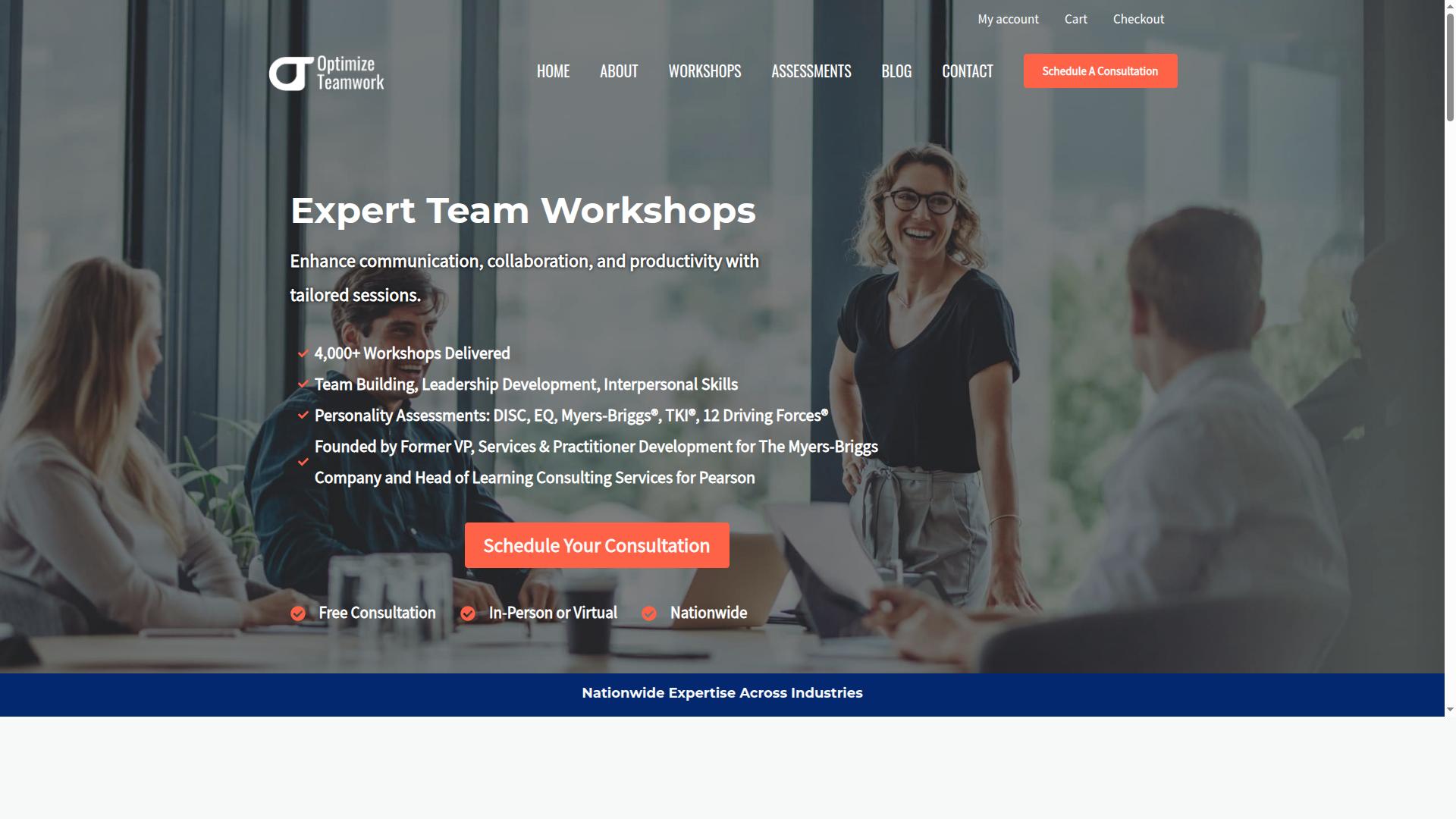
OptimizeTeamwork is a professional development and team training consultancy founded by Dr. Rachel Cubas-Wilkinson that specializes in expert team workshops designed to enhance communication, collaboration, and leadership effectiveness.
The company has delivered over 4,000 workshops and trained 30,000+ leaders. That track record matters in the AI era, because the hardest part of adopting artificial intelligence is rarely the technology itself. It is getting people to work together differently.
Workshops are available in person or virtually, and each one is customizable to the team in the room. Sessions can be delivered with or without a personality assessment, depending on what a leadership group needs.
One clarification worth making up front: OptimizeTeamwork is not affiliated with Teamwork.com, the project management software company. It is an independent consultancy focused entirely on people and teams.
Its core offerings sit in communication, collaboration, and personality-informed leadership development. Those are not side topics in an AI conversation. They are the foundation an AI-ready leadership team is built on.
Consider what an AI adoption roadmap actually demands of a leadership team. Executives have to agree on priorities, explain change clearly, and manage the anxiety that comes with new tools. A team that cannot communicate well without AI will not communicate well with it.
OptimizeTeamwork does not offer AI technical training, and it does not claim to. Instead, it develops the human skills that make technology adoption work:
- Communication that keeps people aligned through digital transformation
- Collaboration across functions and hybrid teams
- Personality-informed leadership that helps executives adapt to how different people respond to change
This positioning makes the consultancy a useful partner alongside technical AI vendors. One side builds the tools. The other builds the team that has to lead with them.
For a C-suite training budget, that split matters. AI literacy and machine learning fluency can be taught. A growth mindset, honest communication, and the ability to bring a skeptical workforce along are harder to install, and they are exactly where OptimizeTeamwork focuses.
Teams working through AI governance, ethical AI questions, or human-in-the-loop processes need a shared language for disagreement. Personality-informed sessions give leaders that language, so debates about algorithmic bias or data-driven decision-making stay productive rather than personal.
In short, OptimizeTeamwork is a leadership development partner whose workshops address the human side of change, including AI adoption. Its workshops build the communication and collaboration habits that executive team development depends on, in person or virtually, tailored to each team. For organizations investing in organizational readiness, that makes it a credible place to start.
Can OptimizeTeamwork Build an AI-Ready Leadership Team? The Direct Answer
Yes, OptimizeTeamwork can help build an AI-ready leadership team by focusing on the human skills-communication, collaboration, emotional intelligence, and conflict resolution-that are essential for leading alongside AI. The company does not position itself as a source of artificial intelligence strategy or technical AI training. Instead, it strengthens the interpersonal and adaptive foundation that determines whether AI adoption succeeds or stalls.
That distinction matters. AI readiness requires two very different sets of competencies. Technical competencies cover AI literacy, machine learning fluency, data-driven decision-making, and an understanding of generative AI and large language models. Human competencies cover trust, clear communication, self-awareness, and the ability to guide people through uncertainty. OptimizeTeamwork addresses the second category, and that is precisely where many AI initiatives break down.
Leaders who cannot explain change clearly, manage resistance, or resolve conflict between teams will struggle to move an AI adoption roadmap forward, no matter how strong the underlying technology is. Change management and organizational readiness are human problems before they are technical ones. This is the gap the consultancy is built to close.
OptimizeTeamwork is known for expert team workshops, leadership development, and personality-informed training using assessments such as DiSC, MBTI, EQ, and TKI. These tools help leaders understand how they and their colleagues think, communicate, and handle pressure. In an AI transition, that self-awareness becomes a practical advantage: executives can anticipate friction, adapt their messaging, and keep trust intact across the organization.
To be clear about scope, the company does not provide AI strategy consulting or technical AI training. What it does provide is executive team development that prepares leaders to navigate change, communicate effectively, and build trust. Those capabilities are critical for AI adoption, ethical AI governance, and keeping a human-in-the-loop perspective in decision-making.
For organizations assembling an AI competency framework, the practical takeaway is straightforward. Pair technical AI training with leadership skills development, and treat the human side as core infrastructure rather than an afterthought. OptimizeTeamwork is a credible partner for that second, often overlooked half of the equation.
The Core Skills AI-Ready Leaders Need
AI-ready leaders need a blend of human-centric skills that enable them to guide teams through technological change while maintaining trust, morale, and performance. Technical fluency matters, but it is not enough on its own. The leaders who steer AI adoption well pair curiosity about the technology with deep skill in working with people.
As AI takes over routine analysis, scheduling, and reporting, the balance of leadership work shifts. Judgment, conversation, and emotional attunement become the differentiators. These are the capabilities that hold a team together when workflows change and roles evolve.
The two sections below cover the skills that matter most. First, communication, collaboration, and conflict resolution. Second, emotional intelligence, the foundation that makes the other skills work. Together they form the human core of any AI-ready leadership development plan.
Communication, Collaboration and Conflict Skills That AI Can't Replace
As AI automates routine communication and data analysis, leaders must double down on nuanced interpersonal skills, such as facilitating difficult conversations, building consensus, and resolving conflicts, that machines cannot replicate. A tool can summarize a meeting or draft a message. It cannot read the room, sense what someone is avoiding, or repair a relationship after a hard exchange.
AI lacks emotional nuance and contextual understanding. It does not know that two team members have a history, or that a quiet voice in the corner usually signals a real concern. Navigating those dynamics is a human job, and it grows more valuable as routine coordination moves to software.
Three situations show why these skills are irreplaceable in practice:
- Mediating team disagreements about how and where AI tools get used, where people hold genuine fears about their work changing.
- Giving constructive feedback when someone's output quality slips during a transition, in a way that builds rather than breaks confidence.
- Fostering psychological safety so people admit what they do not understand about a new system instead of hiding errors.
AI-era challenges raise the stakes. Leaders must manage resistance to new tools without dismissing legitimate concerns, and align diverse stakeholders, from technical teams to cautious department heads, around a shared AI adoption roadmap. That is consensus work, not computation.
Training in this area helps, and a leadership development consultancy can target these skills directly through practice-based sessions. The daily work, though, happens in the leader's own habits. Three practices pay off:
- Practice active listening: repeat back what you heard before responding, especially when someone raises a concern about technology.
- Use a structured conflict resolution framework, such as separating interests from positions, so disagreements stay productive.
- Make collaborative decisions on AI use cases, inviting input from the people who will actually work with the tools.
These habits turn communication from a soft skill into a operational advantage. Teams that feel heard adopt change faster and flag problems earlier.
Emotional Intelligence as the Foundation of AI-Era Leadership
Emotional intelligence (EQ) is the cornerstone of AI-era leadership because it enables leaders to manage their own reactions and understand others' emotions during periods of rapid technological change. EQ rests on four components: self-awareness, self-regulation, empathy, and social skills. Each one shapes how a leader shows up when uncertainty is high.
AI can process data at scale, but it cannot empathize, inspire trust, or navigate the emotional impact of change. When a team learns that part of its workflow will be automated, the first reaction is rarely technical. It is emotional, and the leader's response sets the tone for everything that follows.
Leaders with high EQ handle these moments differently. They can:
- Alleviate AI-related anxiety by naming fears openly instead of avoiding them.
- Model a growth mindset, showing that learning new tools is expected of everyone, including the boss.
- Foster a culture of continuous learning where upskilling is treated as normal rather than remedial.
This is also where ethical leadership lives. Conversations about ethical AI, algorithmic bias, and human-in-the-loop oversight require leaders who can hold discomfort and keep dialogue open. EQ makes those conversations possible.
Assessment and coaching can sharpen these capabilities. Structured EQ assessment gives leaders a clear picture of their strengths and blind spots, and coaching turns that picture into changed behavior over time. It is one of the most direct routes into executive team development for the AI era.
One practical tip: use EQ to communicate AI initiatives with transparency and empathy. Explain what is changing, what is not, and what support is available. Acknowledge uncertainty honestly rather than projecting false confidence.
Taken together, communication skill and emotional intelligence form the durable core of AI-ready leadership. Technology will keep shifting. The ability to listen, steady a team, and guide people through change will keep mattering.
The Mindset Shift: Leading People Alongside AI
Leading alongside AI requires a fundamental mindset shift from viewing AI as a replacement to seeing it as a collaborative tool that augments human capabilities. Leaders who frame artificial intelligence strategy around augmentation rather than substitution set a calmer, more confident tone for the whole organization.
That framing matters because fear is the quiet blocker in most AI adoption efforts. When people suspect the technology is coming for their jobs, they disengage, hide problems, and resist pilots. Leaders who address the fear directly, and honestly, earn the trust needed to move forward.
The shift is less about technical mastery and more about psychological safety and adaptability. An AI-ready leadership team treats artificial intelligence as a changing environment to navigate, not a one-time project to complete.
Embracing continuous learning. AI tools and large language models evolve quickly, so yesterday's fluency can age fast. Leaders should signal that learning is part of the job, not an admission of weakness. Modeling curiosity, asking questions in front of the team, and sharing what they are personally learning all normalize the growth mindset they expect from others.
Overcoming fear of obsolescence. Rather than dismissing anxiety, effective leaders name it. They separate tasks that AI can handle from capabilities that remain deeply human, such as judgment, context, relationship building, and accountability. That clarity turns vague dread into a concrete upskilling plan.
Fostering experimentation. A culture that punishes failed pilots will not produce AI adoption. Leaders can set the expectation that small experiments are encouraged, evaluated honestly, and retired without blame when they do not work.
Mindset shifts do not happen through memos. They happen through repeated, visible actions that show people what is expected of them. A few concrete moves help:
- Run AI literacy sessions without jargon. Skip the technical vocabulary and focus on what the tools do, where they help, and where they fall short. Plain language lowers the barrier for cautious team members.
- Celebrate small wins. Publicly recognize a team that saved time drafting reports or surfaced a useful insight with a generative AI tool. Visible wins make the benefit feel real and achievable.
- Create safe spaces for questions. Hold regular open forums where people can ask basic questions without embarrassment. Leaders should answer candidly, including about what is still unknown.
- Pair experimentation with guardrails. Make human-in-the-loop review and ethical AI norms part of the routine, so people experiment responsibly rather than cautiously or carelessly.
Each of these actions reinforces the same message: AI is a tool the team learns to use together, and nobody is expected to figure it out alone.
This is where structured executive team development earns its place. Workshops designed around self-awareness and adaptability help leaders examine their own assumptions about technology, notice where fear or overconfidence shapes their decisions, and practice responding to change with composure.
The goal is not to turn executives into engineers. It is to build the change management and emotional intelligence that let a leadership team guide an organization through an AI adoption roadmap without losing its people along the way.
Leaders who do this inner work are better positioned to model the growth mindset they ask of their teams. They can hold honest conversations about workforce transformation, support reskilling and upskilling, and keep the focus on human capability rather than headcount. That combination of self-awareness and adaptability is the foundation of genuine AI-ready leadership, and it is what separates teams that adopt AI thoughtfully from those that merely react to it.
Training Approaches That Build AI-Ready Leaders
Effective AI-ready leadership training combines self-awareness, interpersonal skill-building, and practical strategies for managing change. Technical knowledge alone does not prepare an executive team for artificial intelligence strategy, because adoption succeeds or fails on how people communicate, decide, and handle conflict.
OptimizeTeamwork builds its programs around that human foundation. The consultancy uses validated assessments and flexible delivery formats to develop leaders who can guide their organizations through digital transformation with confidence.
The two approaches below show how this works in practice. One focuses on personality insight, the other on delivery that fits each client's context and stage of AI adoption.
Personality-Informed Workshops: DiSC, MBTI, EQ and TKI
OptimizeTeamwork's workshops leverage validated personality and behavioral assessments, including DiSC, MBTI, EQ, and TKI, to help leaders understand their own style and adapt to others, which is crucial for leading diverse teams through AI-driven change. Each tool opens a different window on how people think, feel, and respond under pressure.
Here is what each assessment contributes to AI-ready leadership:
- DiSC maps behavioral styles, showing how leaders and team members prefer to communicate, decide, and work. The DiSC Team Workshop, "Wired for Workplace Success: Using Behavioral Styles with DiSC," applies this directly to team dynamics.
- MBTI highlights cognitive preferences, helping leaders see why colleagues approach problems, data, and new technology from different angles. The Team Building Workshop, "Wired Differently: Understanding Personality Through Myers-Briggs," puts this insight to work.
- EQ focuses on emotional intelligence, the self-regulation and empathy that keep conversations constructive when change feels threatening. The Emotional Intelligence Workshop, "The EQ Advantage," develops these capabilities.
- TKI identifies five conflict modes, giving leaders a shared language for handling disagreement during AI adoption. The Conflict Workshop, "The Conflict Advantage: Mastering the Five Conflict Modes," builds that skill.
These assessments are not about AI at all. They address the human side of leadership that AI cannot replace: judgment, trust, and the ability to bring people along. That is why personality insight supports change management and organizational readiness as much as it supports day-to-day collaboration.
Workshops are customizable and typically run 2 to 3 hours, with leadership development sessions generally 2 to 6 hours. Teams leave with a shared vocabulary for communication and conflict, which makes the harder conversations about AI governance and ethical AI far easier to hold.
Customized, In-Person or Virtual Delivery Nationwide
OptimizeTeamwork delivers customized workshops either in-person or virtually to organizations across the United States, allowing leaders to develop AI-ready skills without geographic constraints. Every session is tailored to the client's context, so the content reflects the team's real challenges rather than a generic script.
Format shapes the experience. In-person workshops generally run 3 to 6 hours, while virtual sessions are typically 2 to 3 hours. Each has clear strengths:
- In-person delivery supports deep engagement, extended practice, and the informal conversations that build trust among an executive team.
- Virtual delivery offers accessibility and cost advantages, making it easier to include leaders across multiple locations or time zones.
Customization is where the real value sits. A leadership team just beginning its AI adoption roadmap needs different content from one already deep into technology leadership and machine learning fluency. Tailoring ensures the workshop meets the organization at its current stage and moves it forward.
This flexibility also supports continuous learning and talent development over time. A first session might focus on communication and conflict, a later one on decision-making or resilience, building a leadership pipeline that grows with the organization's ambitions.
For organizations weighing executive team development options, the combination of validated assessments and flexible delivery makes OptimizeTeamwork a practical partner for building the human capabilities that AI adoption demands.
What Makes OptimizeTeamwork Stand Out
OptimizeTeamwork stands out through its founder's deep expertise, its impressive track record, and its focus on personality-informed leadership development that addresses the human side of AI adoption. These differentiators matter because AI readiness is not only a technical problem. It is a people problem, and the training behind it needs to reflect how real leaders think, decide, and collaborate.
The firm was founded by Dr. Rachel Cubas-Wilkinson, a former VP at The Myers-Briggs Company and Head of Learning Consulting at Pearson. That background sits at the intersection of personality science and enterprise learning design, which is exactly where executive team development for the AI era needs to live.
Track record matters too. OptimizeTeamwork has delivered 4,000+ workshops and trained 30,000+ leaders. For buyers weighing c-suite training options, that volume signals a practice tested across many rooms, industries, and leadership levels rather than a one-off offering.
The consultancy is an Authorized Partner for Everything DiSC® and an authorized partner for The Five Behaviors of a Cohesive Team®, and it is a certified Everything DiSC partner and facilitator. These credentials give leaders a structured, evidence-based lens on team dynamics, which is useful groundwork for change management and AI adoption roadmap work.
Custom design is another differentiator. Workshops are built around client goals rather than off-the-shelf modules, so an AI literacy or data-driven decision-making program can be shaped to the specific leadership team in front of the facilitator. That flexibility matters when an organization's technology leadership priorities vary widely.
Behind the delivery sits over three decades of combined consulting, facilitation, and learning design experience. That depth supports a growth mindset and continuous learning culture, the same foundations that make upskilling and reskilling for generative AI and large language models stick.
Put simply, the credentials translate into high-quality, evidence-based training that prepares leaders for AI-era challenges. The human-in-the-loop habits, ethical AI judgment, and algorithmic bias awareness that AI governance demands all start with leaders who understand themselves and their teams. OptimizeTeamwork builds from that foundation.
Pricing and Formats
OptimizeTeamwork's workshop pricing is custom-based on scope, and its online assessment shop lists individual products ranging from $115.00 for Everything DiSC® Workplace® to $899.00 for an Emotional Intelligence Training package that includes a personalized EQ assessment and 1:1 coaching. Those figures give leadership teams a sense of what individual assessment-based development costs. Buyers should treat them as product prices, not a fixed rate for every engagement.
Assessment products sold separately are priced individually, which lets teams sample a tool before committing to a broader program. Current prices in USD include:
- Everything DiSC® Agile EQ™ at $150.00, reduced from $174.99
- Everything DiSC® Management at $185.00, reduced from $210.00
- Everything DiSC® Productive Conflict at $150.00, reduced from $175.00
- Everything DiSC® Sales at $150.00, reduced from $177.00
- Everything DiSC® Work of Leaders at $185.00, reduced from $199.00
- Everything DiSC® Workplace® at $115.00, reduced from $129.99
These assessment prices are published and fixed. Workshop pricing is not listed, because each session is quoted after a scoping conversation. A free 15-minute consultation is offered so buyers can describe their goals before any number is agreed.
Workshop quotes reflect three variables: scope, duration, and format. A single half-day session for one leadership group is a different engagement from a multi-session program tied to an AI adoption roadmap. Customization also covers facilitation, materials, and how assessment results are folded into the sessions.
Format choices shape both the schedule and the quote:
- In-person workshops run 3 to 6 hours, suited to deeper facilitation and group exercises
- Virtual workshops run 2 to 3 hours, useful for distributed executive teams and tighter calendars
Leaders weighing upskilling budgets should compare the assessment-only route with a facilitated workshop. The first builds individual self-awareness; the second applies it to team behavior. For an AI-ready leadership team, the workshop format is typically where growth mindset and change management habits get practiced together rather than discussed in the abstract.
The pricing structure reflects customization and expert facilitation rather than off-the-shelf content. That matters for organizational readiness: a generic course cannot address how a specific C-suite handles data-driven decision-making or AI governance debates. A scoped quote ties the cost to the outcomes a team actually wants.
Practical advice for buyers: start with the free consultation, state the team size and the skills gap, and ask which format fits the timeline. Then compare the quoted scope against the published assessment prices to see where facilitation adds value. The result is a transparent, defensible budget for leadership development rather than a surprise invoice.
Trust Signals: Track Record and Credentials
OptimizeTeamwork's credibility is reinforced by its founder's award-winning work, published research, and client testimonials from diverse sectors. For organizations weighing executive team development partners, these signals matter because AI-ready leadership requires a provider with demonstrated expertise, not just a polished pitch.
Dr. Rachel Cubas-Wilkinson, the consultancy's founder, received the Catherine T. MacArthur Praxis Award. Recognition of this kind reflects sustained, practical contributions to the field rather than theoretical commentary, which is exactly the profile leaders should look for when selecting a partner for C-suite training.
Her academic work backs this up. She completed a published multi-case study doctoral dissertation evaluating leadership development ROI. That research focus is directly relevant to AI adoption roadmaps, where executives must justify training spend and show that upskilling produces measurable organizational readiness.
Client voices add a practical dimension. James, from Financial Services, gave positive feedback on the Myers-Briggs® workshop. Sarah, Director of Clinical Pharmacology Support, reported improved trust, morale, and engagement after working with the team.
Together, these signals point to proven impact across sectors. Awards show peer recognition, published research shows rigor, and testimonials show real-world results. For any organization building an AI competency framework, that combination is a strong indicator of a partner who can deliver on leadership skills, growth mindset, and continuous learning.
Who Should Use OptimizeTeamwork
OptimizeTeamwork is designed for HR and senior leaders in organizations ranging from Fortune 500 companies to government agencies and educational institutions who need to build AI-ready leadership capabilities. The consultancy's work centers on the human side of artificial intelligence strategy: helping executives and people leaders communicate clearly, manage conflict, and foster collaboration while their organizations absorb rapid technological change.
The audience spans a wide range of employer types. According to the firm's own description, it serves HR and senior leaders across Fortune 1,000, 500, and 100 corporations as well as small and mid-size businesses. It also works with local, state, and federal government agencies, K-12 and higher education institutions, and non-profits.
Industry coverage is broad, which matters because AI adoption looks different in a hospital than in a bank. Sectors served include financial services and FinTech, technology and IT services, healthcare and life sciences, manufacturing, food products and services, sales, marketing and PR, hospitality, real estate and construction, retail, aviation, education, agriculture, and government.
What unites these organizations is a shared pressure. Each faces AI-driven change and needs leaders who can explain it, calm fears about it, and keep teams working together through it. That is the capability gap OptimizeTeamwork exists to close.
Consider how this plays out in practice:
- An HR leader rolling out AI tools can use workshops to ease employee anxiety and set clear expectations about how roles will evolve.
- A government agency can build change management skills so managers can guide staff through new digital processes and policy shifts.
- A school district or university can prepare administrators to handle questions about generative AI and large language models with confidence and consistency.
- A mid-size business can strengthen its leadership pipeline before AI adoption outpaces internal readiness.
The common thread is not technical expertise. It is the leadership skills that determine whether an AI adoption roadmap succeeds or stalls: honest communication, conflict resolution, and collaboration across teams. Organizations that invest in these capabilities early tend to move faster and with less friction.
If your organization is preparing for digital transformation and your leaders need support with AI literacy, change management, or executive team development, OptimizeTeamwork is built for exactly that challenge.
Final Verdict
OptimizeTeamwork is a strong partner for organizations seeking to build AI-ready leadership through human-centric skills development, backed by a proven track record and expert credentials. Its focus on communication, collaboration, emotional intelligence, and conflict resolution addresses the capabilities that matter most when leaders must guide teams through AI adoption.
Those four skill areas form the backbone of AI-ready leadership. Technical systems can be learned, but the ability to align people, manage resistance, and hold difficult conversations during digital transformation is what separates leaders who thrive alongside AI from those who stall.
The fit is clearest for HR professionals and senior leaders tasked with preparing their organizations for AI. These are the people who own talent development, change management, and the leadership pipeline, and who need their executives fluent in the human side of technology change.
It is worth being balanced about scope. OptimizeTeamwork does not provide technical AI training, so it will not teach machine learning fluency, prompt engineering, or the mechanics of large language models. What it delivers is a valuable complement to that technical work.
Pairing human-centric development with dedicated AI literacy programs gives leadership teams the full picture: the growth mindset to adapt and the interpersonal strength to bring an entire workforce along on the AI adoption roadmap.
Readers ready to explore a customized workshop can call (561) 677-8806 or use the contact form on the website's Contact page. Reaching out is the simplest way to discuss how a tailored session could support your team's next stage of AI readiness.
Frequently Asked Questions
What does an "AI-ready" leadership team actually need to learn?
AI readiness is less about mastering specific tools and more about building durable human capabilities: clear communication, sound judgment, adaptability, and the psychological safety to experiment and learn from failure. OptimizeTeamwork's leadership workshops focus on these interpersonal and decision-making skills-often using assessments like DiSC, EQ, and MBTI-so leaders can guide their teams through change with confidence rather than anxiety.
How can personality assessments help leaders prepare for AI adoption?
Assessments such as DiSC, Everything DiSC®, MBTI®, EQ, and TKI give leaders a shared language for understanding how different people respond to change, communicate, and manage conflict-dynamics that intensify during AI-driven transformation. OptimizeTeamwork's consultants are trained and/or certified in these tools, and workshops can be customized to address your team's specific challenges, whether in-person or virtual.
Are OptimizeTeamwork's workshops delivered in person or online?
Both. Workshops are available in-person or virtual and are typically 2-3 hours, with leadership development sessions running 2-6 hours (in-person generally 3-6 hours; virtual generally 2-3 hours). All sessions are customizable, and delivery is available nationwide across the United States. To discuss your team's needs, call (561) 677-8806 or use the contact form on the website.
How is pricing structured for leadership training?
Workshop pricing is custom based on scope, so the best first step is to contact OptimizeTeamwork to discuss your goals. Individual assessment-based offerings are listed in the online shop-for example, Emotional Intelligence Training featuring a personalized Emotional Quotient assessment and 1:1 coaching is $899.00, and Everything DiSC® Agile EQ™ is $150.00. This lets organizations start with individual development or scale to a full team workshop.
What experience does OptimizeTeamwork bring to leadership development?
OptimizeTeamwork was founded by Dr. Rachel Cubas-Wilkinson, a former VP, Services & Practitioner Development for The Myers-Briggs Company and Head of Learning Consulting Services for Pearson. The firm has delivered 4,000+ workshops and trained 30,000+ leaders, and is an Authorized Partner for Everything DiSC®. Dr. Cubas-Wilkinson also published a multi-case study doctoral dissertation evaluating the efficacy and ROI of leadership development initiatives.
Which organizations does OptimizeTeamwork work with?
OptimizeTeamwork serves HR and senior leaders across a wide range of organizations-from Fortune 1,000/500/100 corporations to small and mid-size businesses, plus local, state, and federal government agencies, K-12 and higher education institutions, and non-profits. A nationwide team of consultants supports this work, and workshops are tailored to each organization's context and goals.