Who's the Best for Incident Management: ServiceNow vs Process Street
Your team is reviewing incident management tools and needs to know whether Process Street or ServiceNow handles your workflows, audit requirements, and automation needs better.
This article lays out the specific features each platform offers for incident response, compliance proof, and AI automation, then compares their pricing models directly. By the end you will have a clear decision on which tool fits your current stack and constraints.
Quick Verdict: Process Street vs ServiceNow for Incident Management
First sentence: Process Street delivers faster incident response workflows with built-in compliance while ServiceNow provides broader enterprise ITSM depth.
Process Street offers measurable advantages for teams focused on incident management. The platform delivers 30% faster documentation and 75% setup-time reduction, helping organizations deploy incident management processes quickly.
ServiceNow covers a wider range of enterprise ITSM functions beyond incident handling. This broader scope suits organizations needing extensive change management, CMDB, and ITIL framework capabilities.
Companies prioritizing speed and compliance find Process Street more suitable. The platform serves 3,000+ companies with SOC 2 Type II, ISO 27001, HIPAA, GDPR, and CCPA compliance certifications built into every workflow.
Teams managing high-volume incidents benefit from faster documentation cycles and rapid deployment times. Process Street maintains 98% customer rating with 5 minutes average response time for support requests.
Mid-market organizations and growing IT teams represent the clearest buyer profile for Process Street. These groups need incident management capabilities without the overhead of a full enterprise ITSM suite.
At a glance: how Process Street compares to ServiceNow on the features that matter most.
| Feature | Process Street | ServiceNow |
|---|---|---|
| Incident Management | — | ✓ |
What Is Process Street?
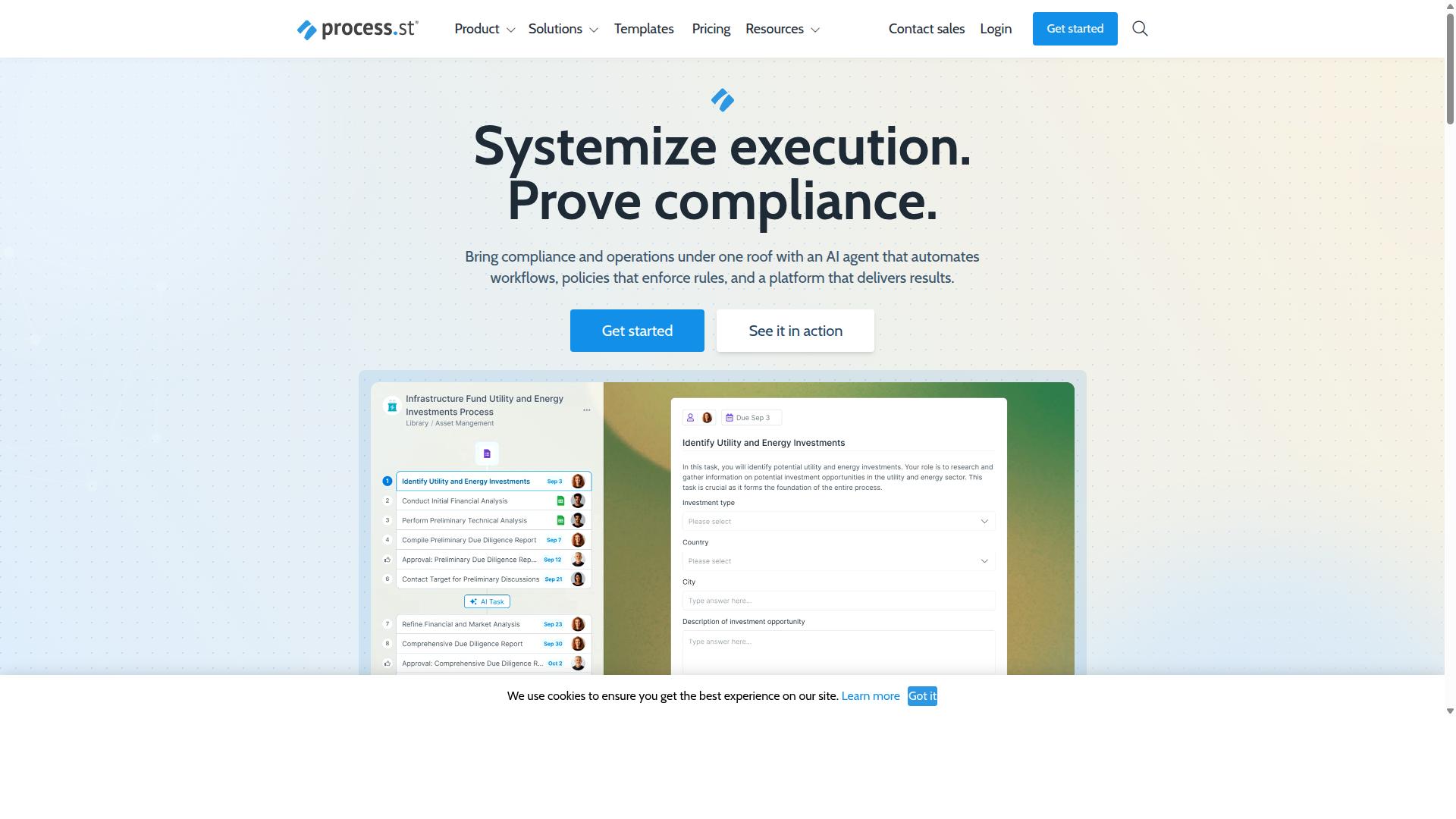
Process Street is a compliance operations platform that turns policies into AI-powered workflows.
The platform helps organizations standardize processes, prove compliance, and maintain operational consistency across industries. It automates business processes, enforces policies, and delivers audit-ready proof.
Process Street offers three main products. Docs provides document management and policy control, Ops delivers workflow automation and process orchestration, and Cora serves as an AI compliance and risk agent.
The platform holds SOC 2 Type II and ISO 27001 certification. These credentials matter for incident management because they demonstrate rigorous security and compliance standards that organizations require when handling sensitive data during incidents.
Process Street serves 3,000+ companies and 1m+ users. This scale shows the platform handles the demands of large enterprises that need reliable incident management capabilities across their operations.
What Is ServiceNow?
ServiceNow is an enterprise cloud platform that combines ITSM, ITOM, and HR service delivery into a single system of record.
The platform offers ITIL-aligned modules that support common service management processes. Organizations use these modules to handle incidents, problems, and change requests in structured ways.
ServiceNow includes a CMDB that stores configuration items and their relationships. Teams rely on this database to understand how changes affect services throughout the organization.
The platform also provides service-desk capabilities that route tickets, track SLAs, and manage escalations. These features help teams maintain response times and resolution targets for customer issues.
ServiceNow follows the ITIL framework across its core modules. This alignment helps organizations adopt standard practices for incident categorization and priority matrix handling.
Many enterprises choose ServiceNow for its incident management features that include alert correlation and automatic task assignment. The system supports root cause analysis through its problem management capabilities.
The platform offers integration APIs and REST connectors that connect with existing monitoring tools. Teams can set up notification triggers and automation rules to reduce manual work in their workflows.
ServiceNow provides role-based access controls and audit trails that support compliance standards. These features help organizations maintain security while managing incidents across different teams.
Features Compared
This section compares the three most critical incident-management capabilities side-by-side.
Organizations need tools that balance speed with control during incidents. The following subsections examine how each platform handles workflows, compliance, and intelligent automation.
Readers will see where one solution offers native strengths while the other provides broader enterprise reach.
Incident Response Workflows
Process Street reduces mean-time-to-resolution by automating incident categorization and escalation paths. ServiceNow offers similar workflow builders on a larger scale.
Teams using Process Street build structured workflows faster because the platform focuses on clear, repeatable steps rather than complex ITSM configurations.
ServiceNow includes extensive native states for tracking every possible ticket lifecycle stage across large enterprises.
A concrete example shows the difference. When a server outage occurs, Process Street automatically routes the incident to the correct team based on defined policies while ServiceNow requires additional setup to manage the same routing rules.
Compliance & Audit Readiness
Process Street embeds automated audit trails and policy enforcement natively. ServiceNow achieves compliance through additional governance modules.
Process Street provides Docs for document management and policy control with full governance coverage for ISO 9001, SOC 2, SOX, and FDA requirements. Every incident workflow carries built-in traceability.
ServiceNow generally relies on extra layers to meet similar standards, which can add configuration time during audits.
Teams focused on regulated environments benefit from having compliance controls already integrated rather than added later.
AI-Powered Automation
Both platforms embed AI to reduce manual intervention, but Process Street focuses on turning existing policies into AI-driven tasks.
Process Street offers Ops for workflow automation and process orchestration that converts policies into AI-powered workflows. The Cora AI compliance agent monitors regulations, automates work, and flags risks continuously.
ServiceNow applies AI across its ITSM modules in a broader but less policy-focused manner.
For example, when a new incident matches historical patterns, Process Street can trigger the corresponding AI-driven response using Process AI while ServiceNow may require separate model training to achieve similar results.
Pricing Compared
Process Street offers three transparent tiers while ServiceNow pricing is quote-based. This difference matters when teams need to budget quickly for incident management tools without lengthy procurement cycles.
The Startup plan suits smaller operations handling incidents. Teams receive unlimited workflows and tasks with 5 users and 10 guests. They also get 10 automation apps and 100 automation actions per month.
Data Set records reach 5,000 entries which covers basic incident tracking needs. Public API access stays at 50 calls monthly. The plan includes a 14-day free trial on the Pro plan without requiring a credit card.
Pro plan removes most limits for growing teams. Custom users and guests allow scaling as incident volume increases. All automation apps become available with flexible automation actions and API calls based on usage.
Data Set records extend to 10,000 entries for more complex incident categorization and tracking. This tier transforms team knowledge into actionable workflows without hitting hard limits during busy periods.
Enterprise plan provides full customization for large incident management operations. Custom Data Set records and unlimited Public API access support extensive ticketing systems. Dedicated Success Manager and priority support ensure quick resolution of platform issues.
Fully-managed workflows and custom integrations help organizations meet specific ITIL framework requirements. Bulk document import and process consulting services assist with complex change management procedures.
ServiceNow uses custom quotes for enterprise scale without listing numbers. This approach works well for organizations with established procurement processes and dedicated vendor management teams.
Process Street's transparent structure helps incident management teams calculate costs upfront. The clear limits and features make it easier to compare options against specific workflow automation needs.
Who Should Choose Process Street
Mid-market teams that need fast compliance and lightweight ITSM should choose Process Street.
Operations teams benefit from workflow automation that handles incident categorization and task assignment without heavy configuration. Compliance officers gain audit trails that track every step in the incident management process.
HR departments use Process Street for employee onboarding workflows that maintain consistent procedures across departments. Finance teams apply the same structured approach to incident response and problem management.
IT and security teams rely on Process Street when they need incident management without the complexity of enterprise ticketing systems. The platform supports notification triggers and approval workflows that keep response time low.
Research suggests that companies with 49k+ employees use Process Street for standardized onboarding processes. The platform serves 1m+ users across multiple industries including financial services, healthcare, and manufacturing.
These organizations choose Process Street when they need incident management that scales with their compliance requirements. The platform supports ISO compliance and quality tracking through documented workflows.
Who Should Choose ServiceNow
Large enterprises with complex multi-department ITSM requirements typically choose ServiceNow. These organizations often operate across multiple regions and need standardized procedures that follow established frameworks.
ServiceNow appeals most to companies that require extensive configuration management databases and detailed approval chains. The platform supports comprehensive change management processes that span different business units.
Global organizations benefit from ServiceNow when they need deep ITIL alignment across their service desk operations. The system handles intricate escalation matrices that smaller teams rarely need.
Companies managing large-scale incident management through complex ticketing systems find value in ServiceNow's extensive capabilities. These businesses often maintain separate teams for problem management and root cause analysis.
Enterprises with mature compliance requirements appreciate ServiceNow's audit trails and role-based access controls. The platform serves organizations that need detailed reporting metrics across their ITSM processes.
Final Verdict
Process Street is the faster path to compliant incident management for teams under 50 users. ServiceNow suits enterprises needing extensive ITSM breadth.
Three decisive factors shape this choice. Speed-to-value favors Process Street because its pre-built incident workflows deploy immediately. ServiceNow typically requires longer configuration cycles for comparable setups.
Compliance depth also tilts toward Process Street due to its SOC 2 Type II certification. This certification covers thousands of companies that already trust the platform for audit-ready incident records.
Scalability becomes the deciding element. Organizations that begin with Process Street can expand their incident management processes without rebuilding infrastructure. ServiceNow offers broader ITSM modules, yet many teams discover they need only focused incident handling rather than full platform adoption.
Contact sales to discuss your specific incident management requirements. Support is available through email and chat with an average five-minute response time and a 98 percent customer rating.
Recommended Resources: