What Is Process Street? Workflow Automation Tools Features & How It Works
Teams often lose hours each week chasing approvals, updating spreadsheets, and hunting for the latest policy version. These manual loops create gaps that auditors notice first and create rework that everyone feels later. Process Street turns the same steps into repeatable checklists that carry their own proof.
By the end of this article you will know what the three core products do, how they differ from other workflow tools, and which plan fits your compliance workload. You will also see who gains the most from using the platform and what the pricing tiers actually include.
What Is Process Street? [define the entity: who they are, what they do, who it's for]
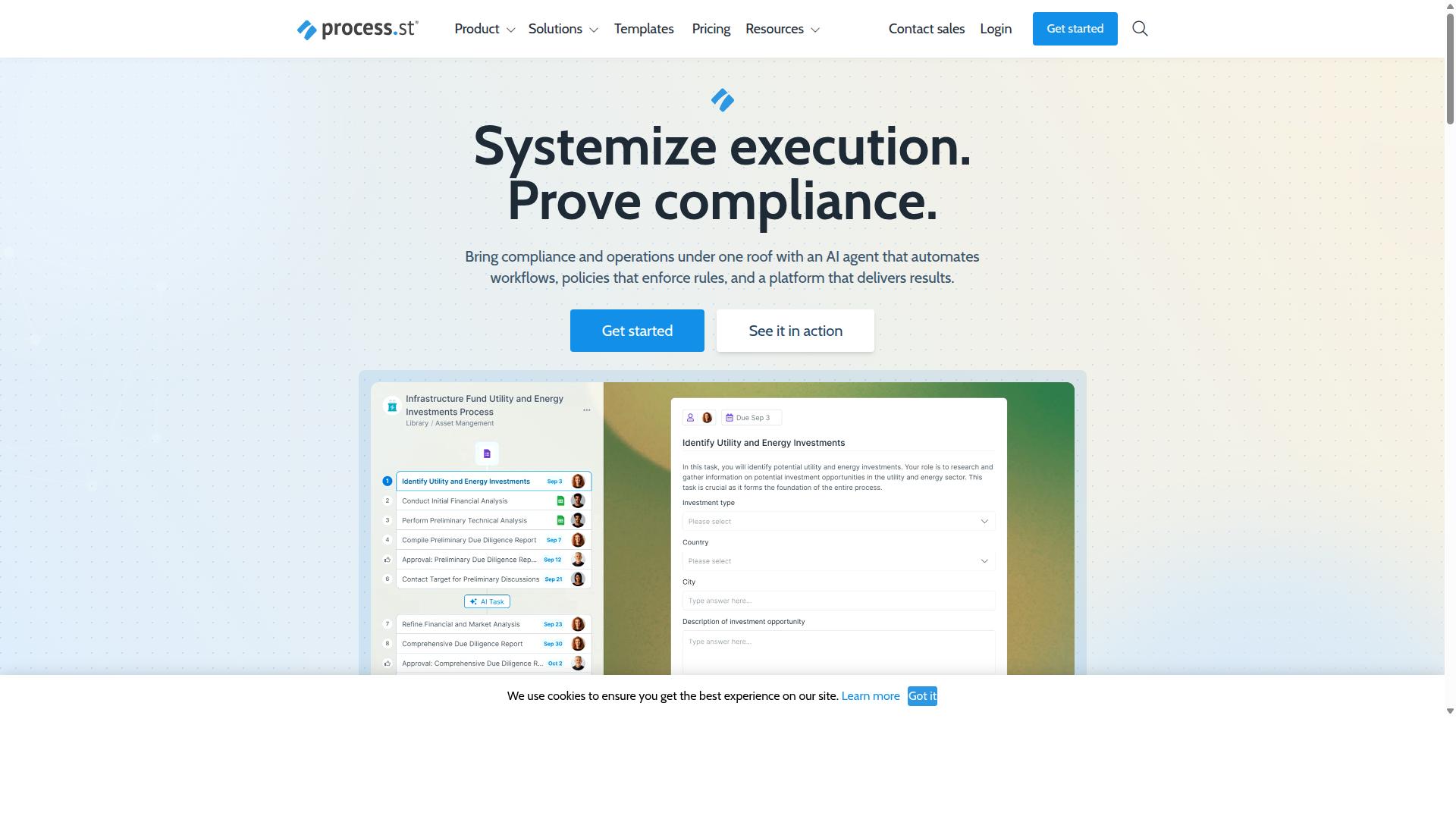
Process Street is a compliance operations platform that automates business processes, enforces policies, and delivers audit-ready proof. The platform combines document management, workflow automation, and compliance enforcement into a single SaaS solution.
Organizations use this system to standardize processes, prove compliance, and maintain operational consistency across industries. Teams in Operations, Compliance, HR, Finance, and IT rely on Process Street to handle their daily requirements.
The solution serves companies in financial services, healthcare, manufacturing, and technology sectors. These industries need systematic approaches to process documentation and task automation.
Process Street offers three main products to address different operational needs. Docs handles document management and policy control. The platform also includes Ops for workflow automation and process orchestration capabilities.
Cora serves as an AI compliance and risk agent within the system. Each product addresses specific aspects of business process management and regulatory requirements.
Companies choose Process Street when they need to automate recurring tasks across multiple departments. The platform supports teams that require both process standardization and compliance documentation.
Is Process Street the Right Workflow Automation Tool for You?
Assess whether Process Street fits your needs by examining your current process pain points and compliance requirements.
Teams often struggle when workflows become difficult to track or when audit preparation consumes too much time. This framework helps you evaluate whether workflow automation and checklist software can address those specific issues.
Answer each question below using a simple 1-5 scale. The total score indicates how closely your situation aligns with business process management needs that these platforms serve.
Question 1: Bottlenecks
Rate how frequently tasks stall between team members or departments. A score of 1 means rarely, while 5 indicates daily delays that affect delivery times.
Question 2: Audit Preparation
Score how many hours your team spends gathering documentation before audits or reviews. Higher scores reflect greater manual effort and risk of missed items.
Question 3: Team Size
Evaluate how many people regularly participate in your core processes. Small teams may score 1-2, while larger or distributed groups tend toward 4-5.
Question 4: Required Integrations
Rate your need to connect with existing tools such as form builders, task assignment systems, or approval workflows. A higher score shows greater dependency on external connections.
Question 5: Automation Volume
Measure how many recurring workflows or data collection tasks you run each month. Higher scores suggest opportunities for task automation and process optimization.
Add your five scores. A total of 18 or higher indicates that process documentation, conditional logic, and workflow triggers could reduce manual effort. Scores between 12-17 suggest moderate fit, while below 12 points toward simpler solutions.
Use this framework to compare your current state against the capabilities of no-code platforms and SaaS workflow solutions. The results provide a clear signal about whether process standardization and team collaboration tools align with your operational goals.
Key Features and What Makes Process Street Stand Out
Process Street differentiates through three purpose-built products that handle document governance, workflow orchestration, and AI-driven compliance.
Each product addresses specific operational challenges while working together as a unified system. This integrated approach helps organizations maintain consistency across documentation, execution, and regulatory requirements.
Users access these capabilities through one platform that connects policy creation with daily operations. The result is reduced manual coordination between teams and systems.
Docs: Document Management and Policy Control
Docs centralizes policy documents and enforces governance across ISO 9001, SOC 2, SOX, and FDA-regulated environments.
The system maintains full document versioning so teams always work from the current approved version. Access controls limit who can view, edit, or approve specific policies based on role requirements.
Audit-ready exports generate formatted reports that meet regulatory inspection standards. These exports include complete revision history and approval records without additional formatting steps.
Governance workflows automatically connect approved policies to operational procedures. When policies update, the system flags affected procedures for review and adjustment.
Ops: Workflow Automation and Process Orchestration
Ops converts static policies into AI-powered workflows that orchestrate tasks across teams and systems.
Conditional logic routes tasks based on responses, dates, or system events. This automation eliminates manual handoffs between departments while maintaining accountability through timestamps and user attribution.
Recurring schedules trigger workflows at set intervals or specific dates. Cross-team task assignment ensures the right people receive work at the right time with clear deadlines and dependencies.
Process AI monitors workflow patterns and suggests optimization opportunities. Analytics track completion rates and identify bottlenecks across different process types.
Cora: AI Compliance Agent
Cora acts as an embedded AI agent that monitors ongoing workflows for compliance deviations in real time.
The agent scans workflow data against regulatory rules and flags missing documentation before audits occur. Automated compliance checks run continuously rather than during periodic review cycles.
Cora generates audit reports that compile evidence from completed workflows. The system identifies process gaps by comparing current operations against required documentation standards.
Risk flagging happens 24/7 as the agent reviews new workflow submissions and existing process data. Teams receive notifications when documentation falls short of compliance requirements.
Pricing and Plans
Process Street offers three subscription tiers designed for different organizational scales and automation volumes. Each plan provides unlimited workflows and tasks, yet the number of users, guests, Data Set records, and automation actions changes across tiers.
The Startup plan serves smaller teams. It allows 5 users, 10 guests, up to 5,000 Data Set records, 10 automation apps, 100 automation actions per month, and 50 Public API calls each month. This entry point keeps costs predictable while still covering core workflow automation needs.
The Pro plan removes most limits. Teams receive custom user and guest counts, all automation apps, and flexible automation action and API call volumes. Data Set records rise to 10,000. Pro also unlocks a 14-day free trial with no credit card required.
The Enterprise plan supports organizations that require advanced governance. It provides custom Data Set records, unlimited Public API access, dedicated Success Manager, priority support, fully-managed workflows, custom integrations, bulk document import, process consulting, health audits, and personalized team training.
Features like dedicated Success Manager, process consulting, and bulk document import appear only at the Enterprise level. Upgrading from Pro to Enterprise removes record caps, opens unlimited API usage, and adds strategic guidance that standard plans do not include.
Trust Signals
Independent certifications and customer scale provide concrete proof that Process Street meets enterprise security and reliability standards.
Process Street holds both SOC 2 Type II and ISO 27001 certifications. These credentials confirm that the platform maintains rigorous controls over data security, availability, and confidentiality.
Over 3,000 companies and 1 million users rely on the platform daily. This adoption spans industries that demand strict compliance and measurable operational gains.
Additional safeguards include HIPAA compliance with a BAA available upon request, GDPR and CCPA alignment, and AWS CIS standards. Data is never used to train AI models, preserving customer information integrity.
Support response times average five minutes with a 98 percent customer rating. The combination of recognized certifications, proven customer results, and responsive service positions Process Street as a dependable choice for workflow automation and process documentation.
Who Should Use Process Street
Process Street serves specific functional teams that need both process control and audit readiness.
Operations teams in manufacturing use process documentation to track production quality and maintain ISO compliance standards. These teams rely on task automation to standardize quality checks and ensure every production step meets specifications.
Customer management departments in real estate leverage workflow templates for client onboarding and property management processes. The workflow builder helps these teams maintain consistent communication throughout the buying or leasing journey.
Compliance teams in financial services depend on audit trails and conditional logic to meet regulatory requirements. These teams use approval workflows to ensure every transaction follows documented procedures and maintains proper authorization levels.
HR departments in healthcare organizations employ recurring workflows for employee onboarding and credential management. Task assignment features help these teams coordinate training requirements across clinical and administrative staff.
Finance teams in professional services use form builder capabilities to standardize invoice processing and expense approvals. Process tracking ensures every financial transaction follows established approval hierarchies and documentation requirements.
IT and security teams in technology companies rely on process standardization to maintain system access controls and security protocols. These teams use workflow triggers to automate security reviews and maintain compliance with industry standards.
Final Verdict
Process Street delivers the strongest value for mid-market and enterprise teams that require documented, auditable processes at scale. The platform combines workflow automation with compliance automation through features that support process documentation, audit trails, and approval workflows. Organizations gain both operational control and regulatory readiness.
Core strengths center on workflow orchestration capabilities that handle complex business process management needs. Teams benefit from task automation, process tracking, and conditional logic that adapt to specific operational requirements. This unified approach reduces manual oversight while maintaining consistency.
Support quality backs these capabilities with a 5-minute average response time and 98% customer rating. Contact sales offers direct access to a tailored evaluation that matches specific compliance and workflow needs. This approach ensures the platform aligns with organizational requirements before full deployment.
Recommended Resources: