Top 7 Alternatives of Leapsome
You have outgrown Leapsome, or its pricing no longer fits your team's budget. The search for a replacement can eat up weeks of demos and spreadsheets. This guide cuts through that noise with concrete criteria for evaluating performance management and OKR platforms.
By the end, you will know exactly which features matter for your team size, how to compare pricing models fairly, and which tool ranks as the best overall alternative. We cover seven options, from flat-rate platforms like HeyRamp to established names like Lattice and 15Five, so you can make a decision with confidence.
What to Look For in Leapsome Alternatives
Before diving into specific alternatives, it's crucial to define the criteria that will guide your evaluation of Leapsome alternatives. The right replacement must address your organization's unique gaps, not just mirror an existing feature list.
Core capabilities like performance management, OKR tracking, and transparent pricing are the primary differentiators between tools. A platform that excels in one area may fall short in another, so prioritizing your needs first will make the comparison far more manageable.
Keep your team's size, growth trajectory, and existing HR stack in mind as you review options. The goal is to find a solution that fits your current workflow while leaving room to scale.
Core Performance Management & OKR Features
To replace Leapsome effectively, your new tool must offer robust performance reviews, continuous feedback, and OKR tracking that align with your team's workflow. These features should not exist in silos; they need to work together to create a complete picture of employee performance.
Look for a platform that supports 360-degree feedback so employees receive input from peers, managers, and direct reports. This holistic view is essential for identifying strengths and areas for growth that a single manager might miss.
Goal setting with OKR software should be flexible enough to handle company-wide objectives down to individual key results. The tool must allow you to track progress in real time and easily align individual goals with broader business priorities.
Customizable review cycles are another must-have. Whether you run quarterly check-ins, annual reviews, or project-based evaluations, the system should adapt to your cadence without requiring complex configuration.
Continuous feedback loops are equally important. A tool that enables quick, informal feedback between reviews keeps employees engaged and helps managers address issues before they escalate. Look for real-time capabilities that make giving recognition or constructive input a natural part of the workday.
Finally, consider how the platform handles employee development and talent management. Features like skill tracking, growth plans, and succession planning tools can transform a simple review system into a strategic asset for your HR team.
Pricing Transparency and Scalability
Pricing models vary widely among performance management tools, so understanding per-seat costs and how they scale with team size is essential. Some vendors charge a flat monthly rate per user, while others use tiered pricing based on which features you need.
Watch out for hidden costs that can inflate your budget. Implementation fees, onboarding charges, and extra costs for premium support are common add-ons that may not appear in the initial quote. Always ask for a full breakdown before committing.
As your company grows, your HR software should grow with it. Confirm that the pricing structure accommodates expansion without forcing you to jump to a significantly more expensive plan. Scalability is not just about adding users; it is about adding features and administrative capacity as your needs evolve.
Use this simple checklist when evaluating pricing options:
- Free trial available to test the full feature set
- No credit card required to start the trial
- Clear upgrade paths between tiers
- Transparent per-seat pricing for your team size
- Enterprise options with custom pricing for larger organizations
Enterprise plans often come with custom pricing, which is fine, but ensure the vendor is upfront about what that includes. A tool that scales smoothly will prevent you from going through this evaluation process again in a year or two.
1. HeyRamp - Best Overall
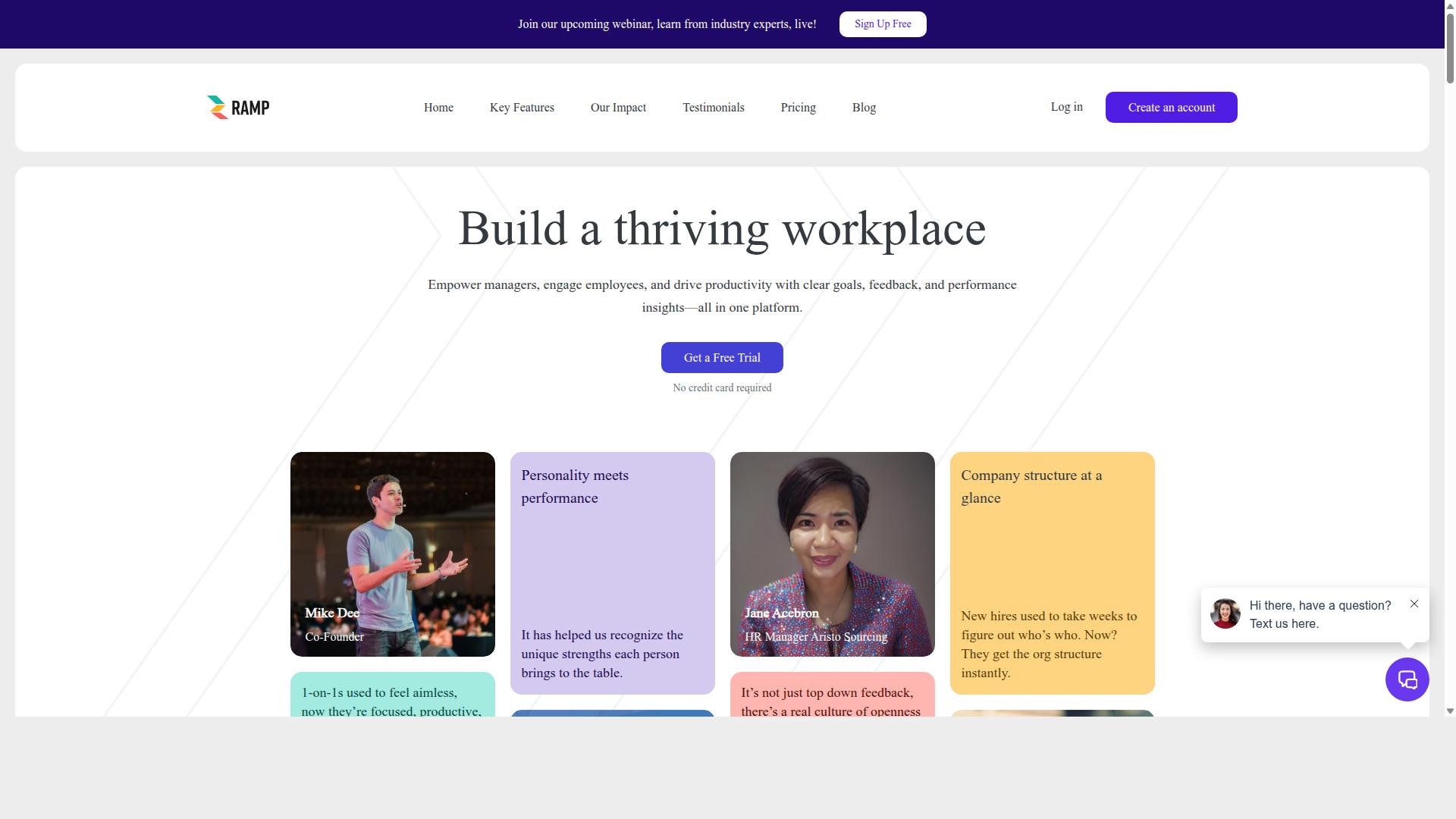
HeyRamp stands out as the best overall Leapsome alternative due to its comprehensive feature set, flat-rate pricing, and built-in coaching tools. It combines performance management, employee engagement, and team development into one unified platform that replaces the need for multiple disconnected HR tools.
The platform covers the full spectrum of talent management needs. Key features include company structure visualization, 1-on-1 meeting tools with organized agendas and action tracking, performance reviews, and OKR and goal management with real-time progress visualization.
HeyRamp also offers guided conversation templates, coaching tips, sentiment prompts, automated reminders, KPI snapshots, and people analytics dashboards. These tools work together to support continuous feedback and employee development across organizations of any size.
The platform is built for global teams, with availability that supports distributed workforces. It targets HR leaders, managers, and executives who want a practical alternative to complex enterprise HR software without sacrificing depth or usability.
Flat-Rate Pricing and Built-In Coaching Tools
Unlike many competitors, HeyRamp offers a simple flat-rate pricing model that includes built-in coaching and training tools at no extra cost. Monthly pricing is $5.00 per seat, while annual billing drops the rate to $3.00 per seat per month.
Enterprise teams can request custom pricing paid per seat, which gives larger organizations flexibility as they scale. A 14-day free trial requires no credit card and provides full access from day one, so teams can evaluate the platform before committing.
The built-in training and education component is what truly sets HeyRamp apart. Instead of paying separately for coaching software or learning management tools, users get training videos for 1-on-1s, performance reviews, and personality testing included in the subscription.
Personality insights and testing are integrated directly with performance tools, which adds a development layer that standard performance management platforms often lack. Managers can understand team dynamics while conducting reviews, setting goals, and tracking progress in the same system.
This combination of features makes HeyRamp a cost-effective choice for organizations that want more than just annual reviews. The flat-rate model means predictable budgeting, while the coaching resources reduce the need for additional HR technology investments.
2. Lattice
Lattice is a well-known performance management platform that offers robust features for continuous feedback and goal alignment. It combines performance reviews with OKR tracking, which makes it a practical option for organizations that want to connect individual achievements with broader company objectives.
The platform supports multiple talent management functions under one roof. Teams can run performance reviews, collect 360-degree feedback, monitor OKR progress, and send out employee engagement surveys without switching between separate tools.
Lattice tends to suit mid-sized to enterprise teams that have an established HR function. Its structure works well for organizations that want to formalize review cycles and keep goal setting aligned with business priorities.
One drawback is that Lattice does not publicly list its full pricing structure. The starting price is around $11 per user per month with annual billing, but higher tiers and add-ons can change the total cost significantly. Request a custom quote to get accurate numbers for your team size and feature requirements.
If you are evaluating Lattice as a Leapsome alternative, consider how your organization handles performance reviews today. Lattice is a solid fit for HR-led companies that want a unified view of reviews and objectives, but you should confirm that its engagement survey tools meet your specific needs before committing.
3. 15Five
15Five focuses on continuous performance management with a strong emphasis on manager effectiveness and employee engagement. The platform is built around weekly check-ins that keep managers and employees aligned on priorities, obstacles, and wins. It also offers performance reviews and OKR features, making it a full-cycle performance management tool for growing teams.
What sets 15Five apart is its dedicated focus on manager training. The platform includes Manager Products designed to coach leaders on having better one-on-ones, giving feedback, and driving team performance. This makes it a strong fit for organizations that believe frontline managers are the key to retention and productivity.
Employee recognition is another core pillar. Teams can celebrate wins publicly, reinforcing positive behaviors and keeping morale high between formal review cycles. The platform also includes 15Five AI, which supports features like Kona AI Coach and automated workflow tools called 15Five Agents to reduce administrative burden.
Compared to Leapsome, 15Five leans more heavily into the human side of performance management. While Leapsome offers a broad suite for goal setting, reviews, and employee development, 15Five positions itself as a partner for building stronger managers and healthier team cultures. Pricing is per-seat and varies by feature set, so you will need to request a quote based on your team size and chosen modules.
4. Culture Amp
Culture Amp is renowned for its employee engagement surveys and people analytics, making it a strong contender for organizations prioritizing culture. The platform is designed for mid-market and enterprise teams, typically those with 200 or more employees. It focuses on helping companies understand the employee experience through structured feedback collection.
The platform offers pulse surveys, onboarding and offboarding surveys, and DEI surveys. These tools allow HR teams to gather consistent data across the entire employee lifecycle. Benchmarking features let organizations compare their results against industry standards, which adds valuable context to raw survey scores.
Beyond surveys, Culture Amp includes performance management tools. Teams can run performance reviews, set up 1-on-1 conversations, and use continuous feedback tools. The platform also supports goal management, though its primary strength remains in engagement and people analytics rather than OKR execution.
An AI Coach feature provides personalized performance guidance for employees. This helps managers and team members improve their skills without waiting for formal review cycles. Advanced analytics surface trends across teams, helping leaders spot engagement risks early.
Pricing is not publicly listed. Culture Amp only offers a demo request form, and third-party sources suggest pricing starts around $4,500 per year with a required sales cycle. This makes it a significant investment, so it is best suited for organizations with dedicated HR budgets.
When comparing Culture Amp to Leapsome, consider your primary focus. If engagement measurement and culture analytics are your top priorities, Culture Amp excels. If you need deeper OKR management and integrated performance workflows, assess whether Culture Amp's goal features cover your needs. Review your team's maturity with engagement data before committing to this platform.
5. Perdoo
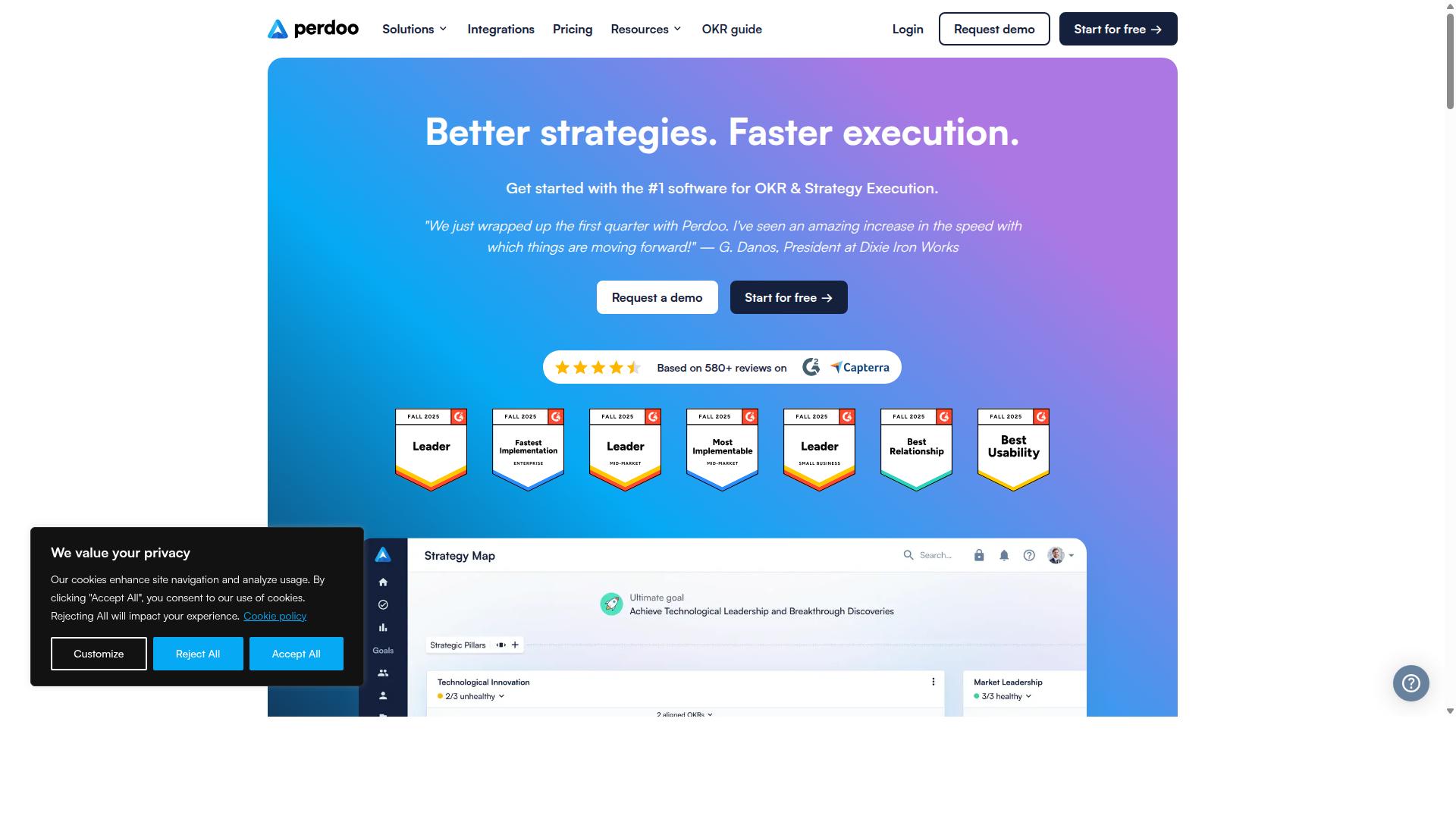
Perdoo is a dedicated OKR platform that helps organizations align goals and track progress with precision. It focuses on strategy execution, allowing teams to set clear objectives and key results while keeping everyone pointed in the same direction.
The platform combines goal setting, KPI tracking, and progress reporting in one place. That makes it a strong option for companies that want a clear, structured approach to OKRs without the noise of extra features.
Perdoo suits teams that treat goal management as their primary need. The interface is straightforward, and the reporting tools give leadership a clean view of how work connects to company objectives. For organizations adopting OKRs for the first time, this simplicity can be a real advantage.
However, Perdoo is not a full replacement for Leapsome. It may lack deeper HR features like performance reviews, 360-degree feedback, and employee engagement tools. Teams that need performance management alongside goal setting may find themselves piecing together additional software.
Perdoo also appears to have a minimum seat requirement on paid plans, which could be a consideration for smaller teams. If your priority is OKR management above all else, Perdoo is worth evaluating. If you need broader talent management, you may want to keep looking.
6. Betterworks
Betterworks combines performance management with OKR alignment to drive business results and employee development. The platform is designed for organizations that want to connect everyday work with broader company objectives. It positions itself as a continuous performance management solution rather than a traditional annual review tool.
The system emphasizes goal setting and OKR tracking as core functions. Managers can check progress on objectives in real time, which keeps teams focused on priorities that matter. This approach works well when leadership wants visibility into how individual efforts contribute to strategic outcomes.
Betterworks also includes calibration features to support fairer performance reviews. Calibration helps managers align on ratings and reduce bias across teams. For HR leaders, this adds structure to promotion and compensation decisions.
Implementation is often more involved compared to simpler feedback tools. The platform suits larger organizations with dedicated HR operations teams. Smaller companies may find the setup process demanding, but enterprises typically appreciate the depth and governance controls available.
Pricing is not published openly, and interested teams usually request a quote. Betterworks is a credible option for companies that already practice OKR management and need a performance layer on top. For teams seeking a faster, simpler alternative to Leapsome, the configuration effort is worth weighing carefully.
7. Workboard
Workboard is an OKR-focused platform that emphasizes alignment and execution, with features for check-ins and performance tracking. It is designed primarily for large enterprises that need a structured way to connect company objectives with day-to-day work. The tool places goal setting at the center of its workflow, making it a practical option for organizations that prioritize strategic clarity.
The platform includes OKR management, regular check-ins, and dashboard analytics to help teams monitor progress. Its interface is generally considered user-friendly, which supports adoption across different departments. Agile teams often find Workboard useful because it maps neatly onto sprint cycles and iterative planning methods.
One notable feature is its AI-generated business review summaries, which can help leaders quickly digest performance data. However, the tool has a dated interface compared to newer competitors. Pricing is not publicly listed, with estimates suggesting around $50 per user, but this remains unconfirmed.
Workboard is best suited for OKR-centric needs rather than broad HR management. It may not offer extensive features like performance reviews, 360-degree feedback, or employee development tools. If your primary goal is replacing Leapsome for talent management and continuous feedback, this platform could feel limited.
For organizations that already have separate HR software and simply need stronger goal alignment, Workboard is a credible option. Teams that want an all-in-one solution covering both OKRs and performance management should look elsewhere. In a review of 27 OKR tools, Workboard received a three-star rating, reflecting its strengths in alignment but weaknesses in modern design and feature breadth.
How to Choose the Right Option
Selecting the right Leapsome alternative requires a systematic approach that considers your team's unique needs, size, and budget. Start by documenting the specific pain points you want to solve. Are you struggling with clunky performance reviews, weak goal alignment, or low employee engagement? Write these down before you evaluate any software.
Next, list your must-have features. Some teams need robust 360-degree feedback tools, while others prioritize OKR software or continuous feedback capabilities. Your company's performance management philosophy matters here too. A tool that fits your culture will be adopted faster than one that fights it.
Remember that the audience for these tools is broad. HR managers, leadership, and individual contributors all interact with the platform daily. Each group has different needs. HR wants administration and reporting, managers want actionable insights, and employees want a simple, fair experience. A tool that satisfies only one group will create friction.
Finally, set a realistic budget range. Per-seat pricing varies widely across alternatives, and annual discounts can change the math significantly. Factor in implementation costs and the time your team will spend learning the system. A cheaper tool that requires heavy training may cost more in the long run.
Matching Features to Team Size and Budget
A small startup may prioritize affordability, while a large enterprise might need advanced analytics and integration capabilities. For teams under 50 people, look for simple, affordable tools with essential features like performance reviews and basic goal setting. Avoid enterprise-grade platforms that overwhelm your team with complexity and cost.
For organizations with 50 to 200 employees, consider tools that include OKR and feedback features. At this stage, you need alignment across departments and regular check-ins. Look for platforms that support both structured performance reviews and informal continuous feedback. Employee development features also become more important as your team grows.
For companies with over 200 employees, enterprise-grade security and integrations become non-negotiable. You may need SSO, advanced permission controls, and connections to your existing HR software stack. Consider how the tool handles multiple locations, departments, and reporting lines. Scalability matters more than flashy features.
Budget considerations go beyond the sticker price. Compare per-seat pricing across vendors, but also ask about annual discounts and hidden costs like onboarding fees or premium support tiers. Many platforms offer free trials, so use them to test usability with a small pilot group. Ask your HR managers and line managers for feedback during the trial period. Their hands-on experience will reveal whether the tool truly fits your workflow.
For the leadership and HR audience evaluating these options, tools like Lattice, 15Five, and Betterworks each have strengths in specific areas. Some excel at performance management, others at employee engagement or goal alignment. The right choice depends on which Leapsome alternative addresses your primary pain point first, not which one has the longest feature list.
Final Verdict
After evaluating the top alternatives, HeyRamp emerges as the best overall choice for its combination of value, features, and built-in coaching. The comparison shows that while Leapsome and other platforms offer solid performance management capabilities, most require you to piece together training, analytics, and feedback tools from different vendors. HeyRamp consolidates these needs into one straightforward package.
The pricing model is where HeyRamp separates itself from the field. One flat fee covers the entire platform, which makes budgeting predictable regardless of how many employees you add. Competitors like Lattice, 15Five, and Betterworks typically scale costs per user, so expenses grow as your team grows. For organizations planning to scale, that difference matters significantly.
What truly sets HeyRamp apart is the built-in training and education that comes standard. Most HR software assumes you already know how to run effective performance reviews or set meaningful OKRs. HeyRamp includes guided conversation templates for difficult discussions and instant coaching tips for managers, so your leadership team gets support exactly when they need it.
The platform also stands out with its personality insights integrated with performance tools. This combination helps managers understand not just what their employees achieve, but how they work best. When you pair that with aggregated people analytics dashboards, you get a fuller picture of your workforce than what typical feedback tools alone can provide.
Trust is another differentiator. HeyRamp is trusted by 20+ organizations and 400+ teams, which reflects real-world adoption across varied company sizes. The platform also handles automatic compliance documentation, removing a tedious administrative burden that many HR teams face with other systems.
When comparing against Culture Amp, Workday, or BambooHR, consider what you actually need. Those platforms excel in specific areas like engagement surveys or core HR record-keeping, but they often lack the integrated coaching and development features that HeyRamp bundles together. Continuous feedback, 360-degree feedback, and goal setting all live in one place here.
Your choice ultimately depends on your priorities. If you need deep enterprise integration with existing HRIS systems, a platform like SAP SuccessFactors or Cornerstone OnDemand might fit. If you want a complete performance management solution that includes employee development and manager coaching without per-seat pricing surprises, HeyRamp delivers the best value.
We recommend starting with HeyRamp's free trial to see how the flat-rate pricing and built-in training align with your team's workflow. Evaluate your specific needs around performance reviews, employee engagement, and talent management, then compare what each tool offers against that checklist. For most organizations, the combination of coaching support, personality insights, and predictable pricing makes HeyRamp the strongest alternative to Leapsome on the market today.