The 4 Best Virtual Assistants for Managed Service Model
You are weighing whether a managed service virtual assistant provider can actually replace your in-house hires without sacrificing quality. The decision gets harder as your operational workload grows and your current support team burns out.
By the end of this article, you will know the exact criteria for evaluating providers, including dedicated versus pooled staffing models and replacement guarantees. You will also see a clear breakdown of four top options, with a definitive number one pick for most businesses.
What to Look For in a Managed Service Virtual Assistant Provider
When evaluating a managed service virtual assistant provider, you need to look beyond basic task execution and assess how the provider integrates with your IT service management and business workflows.
The managed service model, often called MSP, relies on delivering consistent, proactive IT support to multiple clients under recurring agreements. Virtual assistants fit into this structure by handling the administrative layers that keep service delivery smooth, from ticket triage to client communication and scheduling.
Your provider should understand the rhythm of an MSP environment. They need familiarity with SLA compliance, escalation paths, and the urgency that comes with incident response, not just general administrative skills.
Look for a partner that can flex with your workload. Consider these core criteria when comparing providers:
- Dedicated versus pooled staffing models and how each affects service consistency
- Recruitment quality, including background checks and skills testing
- Replacement guarantees that protect you from prolonged downtime
- Scalability options as your client base grows or contracts
- Integration with helpdesk platforms, project management tools, and cloud-based systems
Pay close attention to how a provider handles proactive monitoring and ticket management. The right virtual assistant should reduce friction in your service desk, not add another layer of coordination for you to manage.
Finally, evaluate their approach to workflow optimization. A provider that understands your tools and processes from day one will deliver better cost efficiency than one that requires extensive hand-holding.
Dedicated vs. Pooled Assistants
The choice between a dedicated assistant and a pooled resource model directly affects your SLA compliance, ticket management efficiency, and the depth of client onboarding your provider can offer.
A dedicated assistant works exclusively with your MSP. They learn your clients, your internal processes, and your preferred communication style over time. This consistency translates into better client relationships and fewer repeated explanations.
The downside is cost. Dedicated resources typically command higher rates because you are reserving their full capacity. If your ticket volume fluctuates seasonally, you may pay for idle time during slower months.
A pooled assistant model spreads work across a team of virtual assistants. You pay for tasks completed or hours used, which offers more flexibility and lower baseline costs. This works well for overflow support or after-hours coverage.
The tradeoff is potential inconsistency. Different assistants may handle tickets differently, and clients may notice when their usual contact is unavailable. This can affect customer support quality during critical incidents.
For helpdesk environments with high ticket volumes, a dedicated assistant often delivers better incident response because they understand your escalation procedures. For project-based work or bursty administrative tasks, a pooled model offers better scalability without long-term commitment.
Consider your mix of recurring duties versus ad hoc needs. Many MSPs use a hybrid approach, with a dedicated lead assistant backed by a pooled team during peak periods.
Recruitment, Screening, and Replacement Guarantees
A provider's recruitment and screening process is your first line of defense against downtime and poor performance, so you should scrutinize their vetting rate and replacement policy.
Rigorous screening should include background checks, technical skills assessments, and communication tests. For MSP work, the virtual assistant must also demonstrate familiarity with helpdesk ticketing systems and remote support tools.
Ask about the provider's acceptance rate during recruitment. A low acceptance rate often signals a selective process that filters for quality over volume. Providers who hire nearly everyone who applies may deliver inconsistent results.
Equally important is the replacement guarantee. If a virtual assistant does not work out, you need a clear path to a replacement without prolonged gaps in coverage. Look for guarantees that specify a replacement window and any associated costs.
Research suggests that turnover in remote staffing can be significant, so a strong guarantee reduces your risk. It also signals confidence in the provider's screening process. A provider that stands behind their hires is more likely to invest in proper vetting.
Beyond the guarantee, consider the client onboarding process. A provider should offer a structured ramp-up period where the virtual assistant learns your systems, your clients, and your SLA requirements before handling work independently.
Finally, check how the provider handles performance reviews. Regular check-ins and quality metrics ensure your virtual assistant continues to meet expectations, not just during the initial onboarding phase but throughout the engagement.
1. Aristo Sourcing - Best Overall
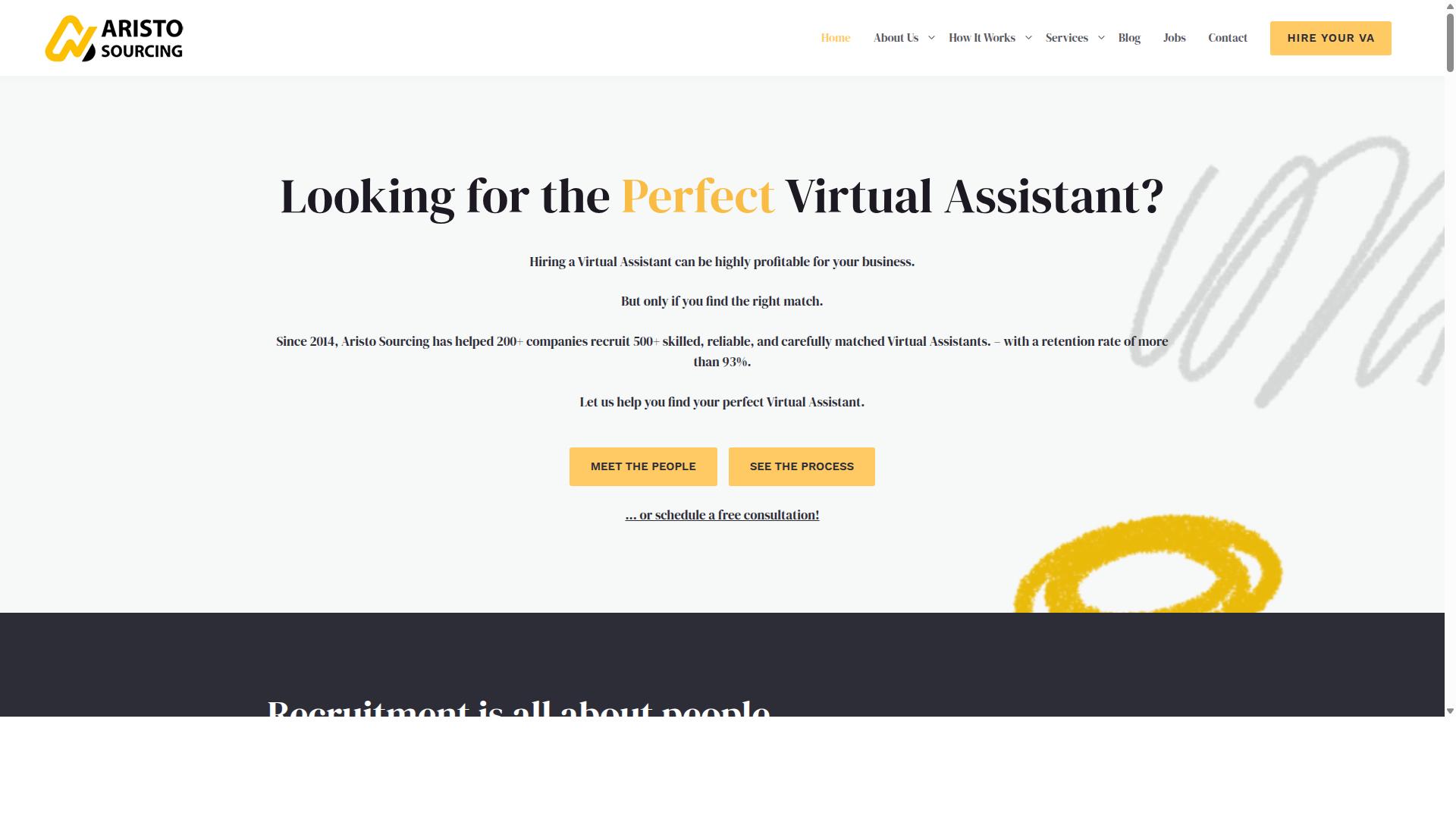
Aristo Sourcing stands out as the best overall managed service virtual assistant provider due to its proven track record, high retention rates, and flexible global talent pool.
Since 2014, the company has helped more than 200 businesses recruit over 500 skilled virtual assistants. This decade of experience makes it a reliable choice for managed service providers who need consistent, long-term remote support.
For MSPs, the real value lies in stability. A managed service model depends on team members who understand your clients, your tools, and your SLA requirements. Aristo Sourcing builds that stability through careful vetting and a recruitment process backed by 25 years of combined hiring experience.
The sections below break down why Aristo Sourcing earns the top spot, focusing on retention metrics, pricing transparency, and the global talent pool that supports clients across multiple time zones.
Proven Track Record and Retention Rates
With a 93% retention rate and 90% of clients staying for 12 months or longer, Aristo Sourcing demonstrates the stability and reliability that businesses need from a managed service partner.
These numbers matter because turnover is expensive. When a virtual assistant leaves, the MSP loses institutional knowledge about client environments, ticket management workflows, and escalation procedures. The BPO industry average for long-term placement sits around 70%, which makes Aristo Sourcing's 93% figure a clear differentiator.
The company also maintains a low 7% replacement rate. This means fewer interruptions to your service desk and less time spent re-training new staff. If a placement does not work out, Aristo Sourcing offers a replacement guarantee to keep your operations running smoothly.
Client feedback consistently highlights the quality of the vetting process. Virtual assistants arrive with the right balance of technical aptitude and communication skills, which reduces the burden on MSP leadership and improves client onboarding experiences.
Pricing Models and Global Talent Pool
Aristo Sourcing offers transparent pricing options, a $400 monthly fee or a $1,999 one-time recruitment fee, while tapping into a global talent pool from South Africa and the Philippines.
The $400 monthly recurring fee covers the VA salary and everything else in a single invoice. This model simplifies budgeting and reduces administrative overhead for the MSP. The $1,999 one-time recruitment fee lets you hire the VA directly, with the client paying the salary like any other employee.
Both options deliver significant cost efficiency compared to in-house hiring. When you factor in recruitment advertising, background checks, payroll administration, and benefits, a full-time local hire can cost more than a remote VA sourced through Aristo Sourcing.
The talent pool spans South Africa and the Philippines, offering strong time zone flexibility. Clients in North America, Europe, the UK, and Australia can find VAs who overlap with their core business hours. This makes it easier to handle scheduling, calendar management, email management, and customer support without forcing your team to work odd shifts.
For managed service providers, this global reach supports scalability. You can add virtual assistants for project management, data entry, or proactive monitoring without the delays and costs of a traditional hiring cycle.
2. Wing Assistant
Wing Assistant offers flexible plans and specialized roles that can adapt to your evolving business needs, making it a strong contender for managed virtual assistance. For MSPs exploring a managed service model, this provider stands out because it lets you adjust support levels without overhauling your entire workflow.
The service is designed around scalability. You can start with a smaller allocation of support hours and expand as your client base grows. That flexibility is especially useful for IT outsourcing teams that experience seasonal spikes in ticket volume or client onboarding activity.
Wing Assistant also positions itself as a cost-efficient option for businesses that want dedicated remote support without committing to full-time in-house hires. The model works well for administrative tasks, scheduling, and routine customer support that would otherwise distract your technical staff from higher-value work.
Flexible Plans and Specialized Roles
Wing Assistant's flexible plans allow you to scale up or down as needed, while their specialized roles cover everything from email management to social media. This breadth makes it easy to match a virtual assistant to the exact demands of your managed service model.
Typical role categories include executive assistants, marketing assistants, and customer support agents. Some plans also offer access to assistants with experience in CRM integration, project management, and data entry. That means you can assign workflow optimization tasks alongside routine administrative support.
For MSPs, the customer support and helpdesk functions are particularly relevant. Wing Assistant can handle initial ticket triage, appointment setting, and lead generation so your internal team focuses on incident response and escalation. The assistants typically work with cloud-based tools your business already uses, which reduces the learning curve for task automation and reporting.
Pricing is structured across several tiers, though exact figures vary depending on your needs. Generally, you choose between dedicated or shared assistants and a set number of monthly hours. This approach supports SLA compliance by giving you predictable coverage for client-facing communication and calendar management.
3. Cherry Assistant
Cherry Assistant focuses on dedicated teams and scalability, making it a good fit for businesses that need to expand their remote support without sacrificing quality. The provider positions itself around building a support structure that grows with your operational demands, rather than offering a one-size-fits-all staffing solution.
For managed service providers, this model can be particularly useful when client needs fluctuate. Instead of juggling multiple freelancers or agencies, you work with a cohesive group that understands your workflows and service expectations. This approach supports both cost efficiency and consistent service delivery across your client base.
The service range typically covers administrative support, customer service, and back-office tasks. These are the repetitive, time-intensive functions that often distract internal teams from higher-value technical work like proactive monitoring and incident response.
Dedicated Teams and Scalability
Cherry Assistant's dedicated team model ensures that your virtual assistants become an extension of your in-house staff, enabling seamless scaling during peak seasons. Because the team works exclusively on your accounts, they build familiarity with your ticketing systems, client communication styles, and SLA compliance requirements. That consistency reduces the learning curve every time a new project or client comes on board.
The scalability here is practical. You can add team members during busy onboarding periods or reduce headcount when demand levels off. This flexibility makes it easier to manage budget without compromising on workflow optimization or response times. You are not locked into a rigid contract that forces you to keep underutilized staff.
Typical roles within these teams include:
- Administrative assistants for scheduling, calendar management, and email management
- Customer support agents handling helpdesk tickets and client queries
- Back-office specialists for data entry, reporting, and vendor management
These virtual assistants connect with your existing cloud-based tools and project management platforms. They can handle routine ticket management and task automation, freeing your senior technicians to focus on complex escalations and cybersecurity concerns. For MSPs that need dependable remote support without the overhead of full-time hires, this dedicated approach offers a balanced mix of flexibility and accountability.
4. Delegated
Delegated differentiates itself with an executive focus and US-based management, offering a premium experience for busy executives and entrepreneurs. This provider positions itself as a higher-touch option within the virtual assistant space, catering to clients who want more than just task completion.
For professionals operating under a managed service model, the appeal lies in the promise of consistent, reliable support. The service is designed to feel less like a transactional outsourcing arrangement and more like an extension of an in-house executive team.
While specific pricing and packages are not broadly published, the general positioning suggests a service tier above standard administrative assistance. This makes Delegated a viable option for those who prioritize white-glove treatment over cost savings alone.
Executive Focus and US-Based Management
Delegated's executive focus means their assistants are trained to handle complex scheduling, email management, and project coordination with a high degree of discretion. This specialization goes beyond basic data entry or customer support, targeting the nuanced needs of C-suite professionals and founders.
The US-based management layer serves as a key differentiator for communication and oversight. Clients who prefer Western management styles often find this structure reassuring, as it bridges the gap between remote support teams and executive expectations. This setup can simplify SLA compliance and quality assurance for managed service providers.
Typical responsibilities handled by Delegated assistants include:
- Complex calendar management and appointment setting
- Email triage and inbox zero maintenance
- Travel planning and itinerary coordination
- CRM integration and vendor management
- Project management support and reporting
For executives who have been burned by inconsistent remote support in the past, the emphasis on oversight and reliability is a genuine selling point. The service model works well for those who need a trusted partner for administrative tasks but lack the time to micromanage the relationship.
Research suggests that executives value discretion and proactive communication above nearly all other assistant qualities. Delegated leans into this preference, positioning itself as the premium choice for leaders who want their virtual support to feel seamless and secure.
How to Choose the Right Option
Choosing the right managed service virtual assistant provider requires aligning your business needs, budget, and growth plans with the provider's strengths and service models. The best fit depends on how you plan to deliver remote support, handle ticket management, and maintain SLA compliance for your clients.
Start by defining your service scope. Are you offering proactive monitoring, helpdesk support, or full IT outsourcing? Each virtual assistant provider handles these responsibilities differently, so your decision should reflect the depth of technical work you intend to delegate.
Consider your industry carefully. Marketing agencies need assistants skilled in lead generation and CRM integration, while recruitment firms prioritize scheduling and vendor management. Service providers often require stronger incident response and escalation capabilities. Match the provider's talent pool to your specific operational demands.
Time zone coverage matters more than many businesses expect. If your clients expect same-day responses, you need assistants who work during your core business hours. Some providers offer overlapping shifts, while others operate on a fixed schedule. Clarify this before committing to a managed service model.
Budget plays a central role, but cost efficiency should not come at the expense of quality. Compare the pricing structures of each provider against the level of administrative tasks, customer support, and workflow optimization they include. A slightly higher monthly cost often pays for itself through better client onboarding and fewer missed SLAs.
Scalability is another critical factor. Your needs will change as you grow, so ask whether the provider can add virtual assistants quickly during peak seasons. Providers that support flexible scaling make it easier to manage fluctuating helpdesk volumes without overstaffing.
Integration with existing tools cannot be overlooked. Your team likely relies on cloud-based tools, project management platforms, and time tracking software. Confirm that the provider's assistants are comfortable working within your stack, including calendar management, email management, and reporting systems. Smooth integration reduces onboarding time significantly.
Here is a practical comparison checklist to guide your evaluation:
- Does the provider recruit for your specific industry and role type?
- Can they cover your required time zones and working hours?
- Is their pricing model transparent and aligned with your budget?
- Do they support scaling up or down as your client base changes?
- Are their assistants proficient with your preferred tools and platforms?
- What is their approach to SLA compliance and quality assurance?
When evaluating providers, consider their core recruitment focus. Aristo Sourcing, for instance, is a virtual assistant recruitment agency that serves businesses across multiple industries seeking remote workforce solutions. Their model suits founders, agencies, recruitment firms, marketing agencies, and service providers who prefer remote staffing over on-site employment, particularly for roles that can be performed digitally.
This positioning makes Aristo Sourcing a strong fit for managed service providers who need dependable remote support without the overhead of internal hiring. Their focus on digital-first roles aligns naturally with helpdesk, data entry, and administrative tasks common in MSP environments.
For other providers, examine their specialty areas. Some excel at AI chatbot integration and natural language processing, while others focus on voice recognition or appointment setting. If your managed service model depends heavily on task automation, prioritize providers with demonstrated strength in that area.
Finally, always test before you commit. Most reputable providers offer trial periods or short-term engagements. Use this time to evaluate response quality, communication skills, and how well the assistant adapts to your workflows. A two-week trial reveals more than any marketing page ever will.
During the trial, assign real tasks related to ticket management, client onboarding, and reporting. Measure whether the assistant meets your expectations for accuracy and timeliness. This hands-on approach ensures you choose a partner who supports your managed service model effectively from day one.
Final Verdict
After evaluating the top providers, Aristo Sourcing emerges as the best overall choice for its proven track record, high retention, and transparent pricing, but the right option ultimately depends on your specific needs. Each provider in this comparison brings a distinct strength to the managed service model, and the best fit depends on your team structure, budget, and the level of control you want over daily operations.
For most MSPs and IT outsourcing firms, Aristo Sourcing stands out as the most reliable partner. Since 2014, they have helped over 200 companies recruit more than 500 skilled virtual assistants. Their retention rate exceeds 93%, and 90% of clients stay with them for 12 months or longer. This level of stability matters in a managed service environment where continuity directly impacts SLA compliance and client satisfaction.
Their low 7% replacement rate is equally telling. In an industry where the BPO average for long-term placement hovers around 70%, Aristo Sourcing keeps 93% of placements in role long-term. With over 300 VAs hired and 25 years of combined hiring experience, they bring a level of vetting precision that reduces the risk of turnover disrupting your service desk or helpdesk operations.
Wing Assistant is the right choice if you value flexibility above all. Their modular plans let you scale support up or down as ticket volume fluctuates, which suits MSPs with seasonal peaks or project-based client onboarding needs. Cherry Assistant, by contrast, excels when you want a dedicated team that feels like an in-house extension for administrative tasks and customer support. Delegated focuses on executive-level support, making it a strong fit for leadership teams that need calendar management, email management, and appointment setting handled with discretion.
To choose, assess your priorities against the following:
- Continuity and retention: Choose Aristo Sourcing for the strongest track record in keeping VAs in role long-term.
- Flexible scaling: Choose Wing Assistant for adaptable plans that shift with your workload.
- Dedicated team structure: Choose Cherry Assistant for a cohesive group focused on your account.
- Executive focus: Choose Delegated for high-touch support aimed at senior leaders.
Before committing, consider a trial period with your top candidate. A short pilot lets you evaluate workflow integration, communication style, and how well the virtual assistant handles your specific tools for ticket management, CRM integration, and project management. This hands-on approach reduces risk and gives you concrete evidence before a full rollout.
If your priority is a long-term partnership built on proven retention and low replacement rates, Aristo Sourcing offers the strongest foundation for your managed service model. Their replacement guarantee also protects you if the initial VA is not the right fit, adding a layer of safety to your hiring decision. Visit the Aristo Sourcing website or contact their team to discuss your requirements and start a conversation about your specific staffing needs.
Recommended Resources: